DON'T MISS ANY OF
MY BLOG POSTS
Enter your Email


Preview

 
culinary school


Kids Can Cook

Learn Why
Kids Can Cook


LG Electronics


Soy-Glazed Mahi Mahi with Cilantro Pesto Shrimp

November 6th, 2009 by RG in Seafood Recipes

The 2009 Winner of the LG Electronics / Bon Appetit’s Life Tastes Good Competition Kristine Snyder Interview featuring her winning Mahi Mahi recipe.

LG Electronics Cooking Contest Winner

I have been following this cooking contest and am thrilled to have been able to interview the winner, Kristine Snyder, who will be traveling to Thailand to compete in a global cooking event. If you want to read more about the contest, the judges and other competitors, go to Taste of Something Better.

Kristine is from Maui, HI and prepared a Soy-Glazed Mahi Mahi with Cilantro Pesto Shrimp dish that I will share with you in the interview. I would like to thank LG Electronics and Bon Appetit for helping make this interview possible.

So let’s get started by asking how you became involved with the LG Electronics/Bon Appetit Life Tastes Good Cooking Competition?

I am a member of a website called Cooking Contest Central which lists recipe contests and when I read about LG’s fabulous prize packages, I decided to give it a try.  I emailed my entry the day before the deadline (I never submit a recipe early because I usually want to change something) and was notified that my recipe was in the top 10.  After that, Bon Appetit prepared the 10 recipes and narrowed it down to the 3 finalists (I was on pins and needles during that waiting time!)

Did you think from the start you had a chance of winning the New York competition and be on your way to Thailand to compete in a global cooking cook-off?

Always hopeful but I am realistic which meant having a 33.3% chance of going to Bangkok.  I also didn’t know anything about my competition which probably was a good thing since their recipes looked and sounded delicious!

What was your strategy for choosing your recipe for mahi mahi and shrimp flavored with soy, lime and cilantro?

I really didn’t think of it as strategy - I just put together some of my favorite Hawaiian flavors (which also includes ginger, garlic, and Hawaiian Portuguese Sausage).  After moving to Hawaii in 1998 I immediately fell in love with the Pacific Rim ingredients and tastes and I cook with them about 80% of the time.  I had created a recipe similar to this one for another contest but it wasn’t chosen so I decided to try again.  The two lessons here are 1) how difficult it is to get into cooking contests and 2) if you know you have good recipe, stick with it and keep trying!

By the way, do you mind sharing your recipe with all my readers?

Love to….

(more…)


How Do You Know When The Chicken Is Done

November 4th, 2009 by RG in Chicken Recipes

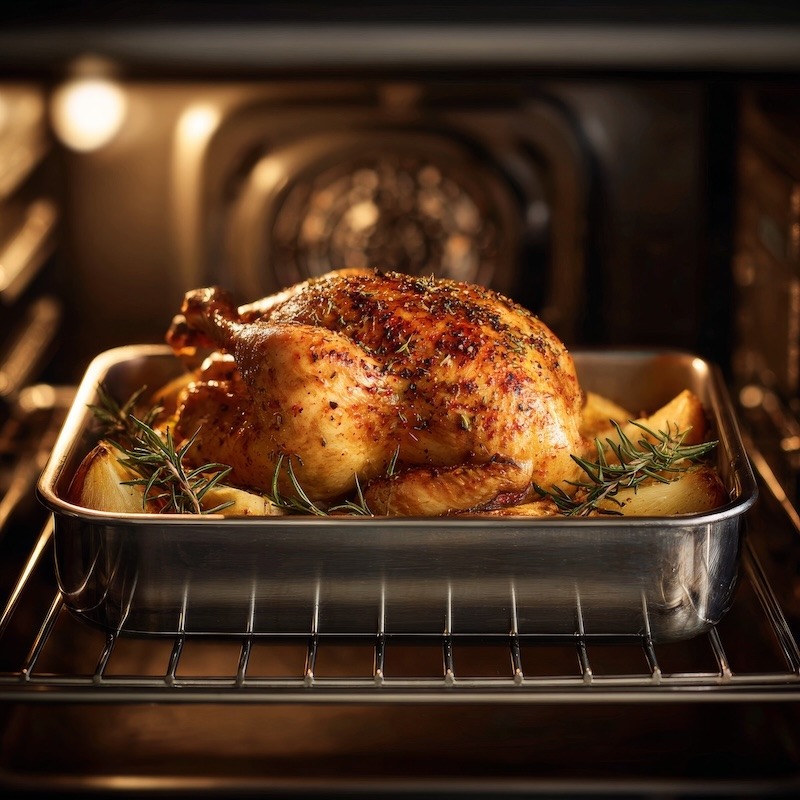
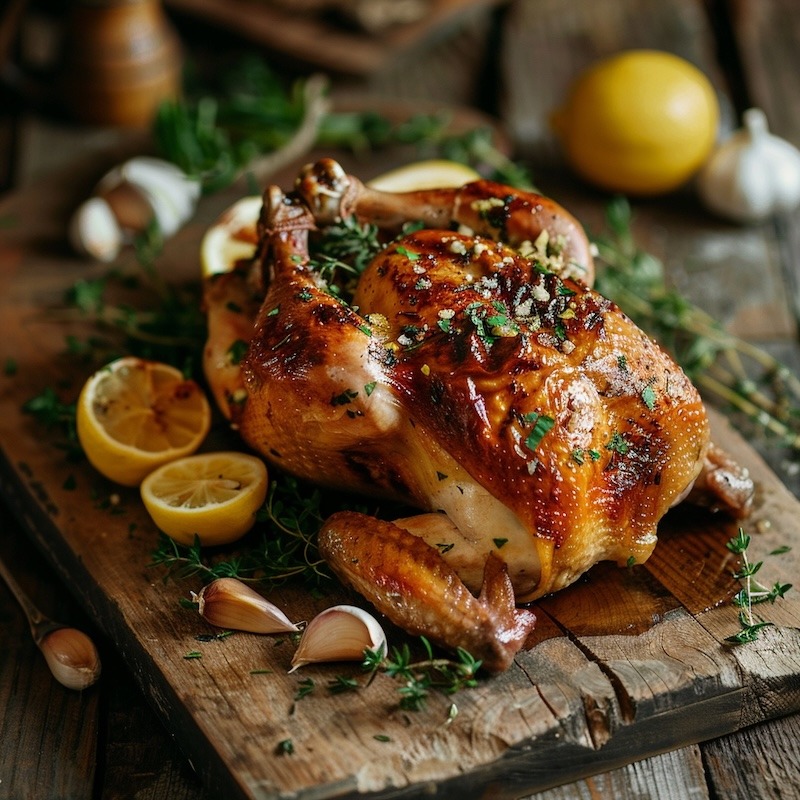
Roast Chicken

You’ve all seen those directions in your roast chicken recipes:  “Roast until Done.”  Gee, thanks for all the help. The same directions can be found in recipes for grilled chicken, sauteed, pan fried or any other way there is to cook this favorite bird.

Intuitively, we know what “done” looks like - the meat should be white all the way through, not pink.  It should also be completely opaque, no translucent spots.  And pink or bloody liquid is a no no.  The juices should always run clear.

That’s all well and good, and important, too, especially with salmonella’s being such a problem when it comes to poultry.  But how can we tell for sure when the meat is done all the way through to the bone and not overcooked?  The skin can be golden brown and the chicken can smell great, but it might not be done in the center or it may be completely overcooked and dried out.

Cooking Variables

For starters, and most importantly, it is almost impossible to go by stated cooking times in recipes. Start looking at those times as estimates and estimates only.  There are so many different variables at play when it comes to timing recipes; the size and make of the oven, whether or not it’s a convection oven, did you preheat the oven and the precise size of your chicken and its temperature when you put it in the oven in the first place.

If you pull a chicken out of the refrigerator and it’s 40ºF, common sense tells you it will take longer to cook than a chicken that’s sat out for 30 minutes and reaches a standing temperature of 60ºF. For these reasons, “350º F for 45 minutes” is not very helpful.

Why?

Besides all the variables just mentioned, most of us are so afraid to undercook food that we tend to let it cook longer forgetting that all meats and poultry need to rest to redistribute the juices and while it is resting, it is continuing to cook.

At best, consider “time and temperature” a ball park estimate.  Set the oven to 350º F, but start checking the internal temperature at 35 minutes, realizing it could take well over an hour.  Forget the notion that the time and temperature estimations for doneness is the holy grail. Sure it’s much easier to cook this way, but also a great way to get over or under cooked chicken. Remember - Time & Temperature is just an estimation

Whether you poach, grill, saute or roast your chicken, you need to find a reliable measure of doneness.  Cooking a bird for several hours “just to be on the safe side” is just as bad as serving undercooked meat.  It might be even worse.  You can always cook the chicken more, but there is no way to uncook it.

Popular Suggestions That Don’t Work

Many cooking resources advise that you cut into the leg to see if juices run clear.  There are a couple of problems with this method.  For one, and rather obviously, not everyone cooks whole chicken, and often we cook boneless cuts.  Another issue is that when juice runs out of the chicken, as it most certainly will when you slice it open, you end up with dry chicken.  So, even if you haven’t overcooked the bird, it might still taste overcooked just because it is drier than it should be.

Other cooking resources advise you to jiggle or tug on the leg to see if the bone feels loose in the socket.  I don’t think much of this method, especially since it’s the way I test for doneness when I’m slow cooking a rack of baby back ribs.

Yes, the meat will be done when the bone is loose in the leg socket, but most likely it will be overdone, as the looseness is a sign that the connective tissue that holds the bone in place has gelatinized. This is a good thing when what you are looking for is lip-smacking goodness.  It’s not such a good thing when you want tender, juicy, perfectly cooked roast chicken.  Plus, as I stated before, you might not always have a bone in a socket to wiggle.

How to Know When the Chicken Is Done

The most reliable and accurate way to test for doneness, regardless of cooking method, is using an instant read thermometer.  Just pierce the meat in the thickest part, being sure not to hit bone (the bone will be hotter than the meat).  Try to aim for the center of the piece of meat.  If you’re not sure, go ahead and pierce all the way to the bone (or all the way through, if you’re cooking a boneless cut) and then back it out halfway.

You’re looking for a final internal temperature of 165º F for white meat and about 180º F for dark meat.  Keep in mind that these are the USDA recommendations, and many people feel that they are set too high.  They are set for your safety though, so I find it is best to stick with these temperatures, especially when dealing with poultry.

Once you take a piece of meat out of the oven, its temperature will continue to rise.  How much it rises depends on the size of the piece of meat and the temperature at which you were cooking it.  For smaller pieces of meat, such as breasts, the temperature may only rise one or two degrees.  For larger cuts and whole birds, the temperature can continue to rise as much as 10-15 degrees over a half hour to forty-five minutes.

Keep carryover cooking in mind when you roast any sort of meat, and allow for it in your temperature readings.  For example, when roasting a whole chicken, take it out of the oven when the breast reads an internal temperature of 155º F-157º F, cover it and let it rest, allowing the temperature to rise to 165º F.

When roasting a chicken breast, remove it from the oven at an internal temperature of 162-163F, letting it rest, covered, until it reaches 165º F.  Not only will resting the bird allow for carryover cooking, it also gives the juices in the bird time to redistribute evenly throughout the meat, resulting in a juicy, tender bird.

Experience

You might ask if professional cooks use instant thermometers and I can tell you they all carry them on their person at all times because it is the law and I imagine most of them use them. I’m also sure after cooking thousand and thousands of chickens they intuitively know when they are done. I’ve even been told by one chef she could hear when a chicken breast is perfectly cooked while sauteing. Cooking by ear - sounds interesting.

You may find it a pain at first to check everything you cook with an instant thermometer but I think after a few perfectly cooked outcomes, you will make it a standard part of your cooking experience.

Your Experiences

Please share with us your tips for cooking delicious, moist chicken in the comment section below.

Related Topics

Instant Thermometers

Chicken Recipes

Blog Chicken Recipes

How To Saute


Roasted Wild Striped Bass Recipe

October 28th, 2009 by RG in Seafood Recipes
Fishmonger Andy with Wild Striped Bass

Fishmonger Andy with Wild Striped Bass

While at the farmers market, I asked my friend Andy the fishmonger from Ardmore Seafood Market what was really fresh, and he pointed me to the whole wild striped sea bass. You could see with one glance the fish was really fresh by the color, clearness of the eyes, the shiny skin and most importantly the smell or, more precisely, lack of smell.

Andy pulled out a 5 pounder as shown in the picture, but it was way more than I needed for two adults and two kids. We agreed on a 3 pounder that he removed the head, scaled, and then thoroughly cleaned the cavity. We ended up with just over 2 pounds of fish, perfect for the four of us.

Get to Know Your Fishmonger

I’m sure Andy is great with all his customers, but the fact that I take the time to say hello every week and ask questions goes a long way to making sure I get his complete attention. When I ask him what’s really fresh each week, he doesn’t point me to the most expensive piece of fish but directs me to something just off the boat. If I’m looking for a bargain, he is quick to come up with something like the striped bass.

What really impressed me is how he offered to pack the fish in ice in case I was going to be doing more shopping. I didn’t ask; he just offered.  You should never hesitate to ask your fish person to do the same if you are going to be out and about. Fish is expensive and you want to keep it as fresh as possible. A little ice costs them very little and the service will keep you coming back.  As a back-up plan, always bring a small cooler and some ice packs with you on your trips to the seafood market.

Tarragon

Did you know tarragon is in the sunflower family? It has a bittersweet flavor and smells a lot like licorice.  The flavor intensifies when heated, so be careful how much you use.  Most of us have heard of tarragon infused oil or tarragon chicken but it is also good with fish, rabbit, veal, pork and potatoes.

I will tell you 1 tablespoon of fresh tarragon = 1 teaspoon of dried but for this dish try to use fresh only. It really makes a huge difference in flavor, because the oils in dried tarragon dissipate and mellow.

striped bass ingredients

Ingredients

  • 2 tablespoons pumpkin seed oil (olive oil will work fine but it is close to Halloween)
  • 1 lemon, cut in half (don’t worry—you’ll use both halves)
  • 2 pounds of cleaned wild striped bass
  • 4 sprigs of fresh tarragon –  3 for stuffing the striped bass cavity and one for mincing
  • Salt & freshly ground pepper –  I like using course sea salt or kosher salt, easier to handle
  • 1 medium eggplant, cut into ¼  inch slices across
  • 3 large or 6 small shallots, sliced
  • 12 kalamata olives, pitted and cut in half
  • ½ cup dry white wine

How to Prepare Roasted Striped Bass with Eggplant and Shallots

Preheat your over to 425° F.

If your fishmonger did not thoroughly clean the fish cavity, I recommend you give it a good cleaning, making sure to remove any blood that may be present. Of course, you will want to scale the fish too if that wasn’t done.

Combine the juice from half of the lemon with the pumpkin seed oil and rub all over the fish inside and out.  Season with salt and freshly ground pepper, and place three of the tarragon sprigs inside the bass cavity.

In a roasting pan big enough to hold the fish, line the bottom of the pan with the sliced eggplant.  Then, add the sliced shallots. Add the wine to the pan, and then the wild striped bass.

Place the olives and lemon slices on top of the fish. Sprinkle with the minced tarragon, and roast in the oven for 25 – 30 minutes until the fish reaches an internal temperature of approximately 135° F. - 140° F.  The flesh should be opaque and flake easily.

Roaste Striped Bass

Presentation

I suppose in a restaurant they would serve this dish tableside whole and have the waiter remove it from the bone in perfect portions. I’m not that good, so I am asking for any and all suggestions on alternative ways to serve the fish at home.

After I let the fish rest a few minutes, I removed it from the pan and took out the backbone in one fell swoop.  There were still some rib bones left, which were not a problem for my wife or me, but even microscopic bones would be enough to cause my girls to stop eating.  You can be sure I was careful to serve them only boneless pieces!

I cut the fish in half following the backbone line, removed bone-free pieces for the girls and served the rest to my wife and myself.  I served the fish on a bed of couscous and topped it with a few olives. I served the eggplant and shallots on the side. A drizzle of pan juices over the fish finished the plate. Everyone loved the fish, and I can’t wait to try it again with some other ingredients.

I used shallots and eggplant but onion and yellow squash would have worked and I encourage you to try ingredients you enjoy and would like to serve with this dish.

Food & Wine

The Money Spider WineMy wife brought home a 2006 Australian white wine called The Money Spider made from Roussanne grapes. This is a Rhone styled wine that is made to be drunk with food and not alone. I couldn’t figure out the connection with the name so I went to the winemaker’s web site and learned the following,

The first crop of Roussanne from the 2000 vintage was found to be covered in a sea of tiny “Money Spiders”. Popular belief is that kindness to these active little creatures will bring good luck, hopefully in the form of money. Being nature-lovers and slightly superstitious to boot, we refrained from sending the spiders to their death and hence were not able to release our first Roussanne until the 2001 vintage by which time the “Money Spiders” had learned their lesson and moved from the vineyard to the bushland surrounding the winery.

The wine has a “orange blossom” nose with an apple taste on the palate. I found it big enough to go with the meaty striped bass and was a nice alternative to the Chardonnay we normally would drink with a meal like this. My wife had a glass after dinner and thought it wasn’t a good as with the meal but we both enjoyed it with the dish.


Next Article »