DON'T MISS ANY OF
MY BLOG POSTS
Enter your Email


Preview

Where Does
The Reluctant Gourmet
Shop Online?
Amazon.com
amazon.com


culinary school

Contributing Writers

Lola Baldwin
Jenni Field
Mark Vogel


LG Electronics


Back Bay Seafood Crab Cakes

August 17th, 2010 by RG in Seafood Recipes

The Most Delicious Crab Cakes

crab cakes

Could be the best crab cakes I’ve ever tasted. I’ve heard about Back Bay Seafood in Stone Harbor, NJ for years. People have told me they have the best crab cakes and crab chowder on the island. Last night I had the opportunity to taste their crab cakes and they are right.

I was surprised when I entered their store by how small it is. There were three other customers in the shop and when I opened the screen door, they all had to move over so I could get in. In front of me was the back of a big refrigerator and behind that was a small kitchen where I could see three or four people moving around.

Just to the left of the door was the cash register and a nice woman who took my order and checked me out. I was told there could be a long wait but I think that is when you order prepared foods like their Seafood Combination Dinner - Fried or Broiled. When you are there just for their U-Cook-Em Crab Cakes, there is little or no wait unless there is a line out the door I guess. This night there was no line.

The nice lady at the counter asked me if I need cooking instructions and of course I reluctantly said yes. I thought she said bake them at 400 degrees for 15 minutes but when I read a review on their web site, I found articles saying to broil them at 400 degrees but I’m not sure how you do that. When I set my oven to broil, I stick it on broil and am not sure what the temperature it. We baked them and they came out delicious.

How Are They Made

I’m not sure if either co-owner Tom Hegyvari or Keith Meloni are going to share their crab cake recipe with me, but I’ll try to contact them and give it a try. I do know from eating them that there is little or no filler in these 5 ounces of crab delight and they may have a subtle coating of breadcrumbs or corn meal on the surface.

I also know from reading the articles on their web site that they use a combination of jumbo lump and blue crab claw meat, herbs and use mayo to bind the crab meat together.  I don’t know if they are getting their crab meat locally, but I’m guessing if not it is from Maryland or somewhere on the East Coast. I hope so.

We always purchase fresh crab claws from the Avalon Seafood Market, a great source for local seafood but when we stopped there after picking up the crab cakes we were disappointed when they didn’t have any. Now they are selling a canned - pasteurized product with crab meat that comes from the “Sea of Cortez and the Pacific Ocean – locations known the world over for producing the best Blue Crab.”

They were ok if you put enough cocktail sauce on them but nowhere near as good as the fresh crab claws from Maryland. There was an off taste that I’m guessing comes from the processing and the meat is not as tender or delicate as the fresh local claws.

Back to Back Bay Crab Cakes

The crab cakes are not cheap, $8.50 each but when you compare that with what they charge for crab cakes at one of the nicer local seafood restaurants ($30 to $40 for a pair and I can’t image they could be better than these), the price is reasonable.  And eating them at home gives you yet another opportunity to enjoy fresh local Jersey corn and tomatoes.

If you are in the Stone Harbor - Avalon area, I encourage you to go to Back Bay Seafood and give their crab cakes a try. And while you are there, you might want to taste their crab chowder and lobster bisque. I know I will next time I’m over there. I think I read they will even ship crab cakes to you overnight.

And of course, if you have a great crab cake recipe you would like to share, I would like to hear about it.

Related Articles

Crab Cake Recipe

Red Pepper Coulis to serve with Crab Cakes


Poached Salmon with Dill Sauce Recipe

April 15th, 2010 by RG in Seafood Recipes

poached salmon with dill sauce

Poaching is a wonderful way to keep delicate fish moist and flaky.  If you follow the simple steps for poaching and have patience, you will be rewarded with a succulent main course.  Poaching is a gentle moist heat technique of cooking and is perfect for a fish dish like this one but can be used for meat and chicken. And I’m guessing most of you have probably had poached eggs sometime in your life or what about poached pears?

Check out my cooking technique page on How to Poach to learn more about poaching, when to use this technique and steps for achieving great results.

Poached Salmon with Dill Sauce
Serves 4

Paired with a vibrant green sauce, this dish shows well on a plate and sits well in the stomach!

Ingredients

1 2-pound filet of salmon
Salt and pepper
½ cup wine
Fish stock (broth), approximately 2 quarts, to cover salmon
Bouquet Garnis—2 dill sprigs, 5 peppercorns, ½ shallot, 2 sprigs flat-leaf parsley, tied together in cheesecloth.
½ cup diced onion
¼ cup diced carrot
¼ cup diced celery

Salt and pepper the salmon on both sides.

Add the wine, broth, bouquet garnis, onion carrot and celery to the poaching pan.  Bring liquid up to about 160 degrees, F.  Hold at this temperature for fifteen minutes.

Carefully lower the salmon into the pan.  Add more broth, if necessary, to cover.

Gently poach the salmon until it reaches an internal temperature of 140 degrees, F.

Dill Sauce

1 bunch of dill
½ bunch flat-leaf parsley
6 oz. crème fraiche
Lemon juice, to taste
Salt and pepper, to taste

Remove larger stems from the dill and the parsley.  Put the ingredients in the bowl of your food processor.  Process with on-off pulses until you have a thick sauce.  Taste, and add more lemon juice, salt, and/or pepper, if needed.

The dish can be served warm or cold.  If serving cold, make the salmon well ahead and chill it in its poaching liquid.  Before serving, make the sauce.  Then, slice the salmon into four portions, topping each portion with ¼ of the sauce.

If serving warm, gently warm the sauce on the stove, stirring constantly.  Serve over the warm salmon.

Related Topics

How to Poach


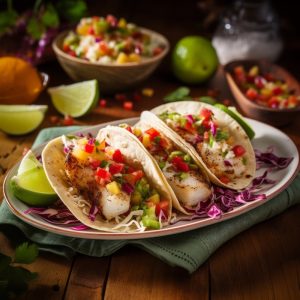
Grilled Mahi Mahi with Tomato-Orange Salsa Recipe

March 15th, 2010 by Mark Vogel in Seafood Recipes

A Zest for Conquest

grilled mahi mahiHernando de Soto (ca. 1500- 1542) was a Spanish conquistador.  In other words, he was an invader and a pillager.  History and modern culture tend to lionize the early European conquerors, but let’s face it, their goal was to seize other people’s territory, plunder the natural resources, pilfer whatever valuables they could, and eliminate any natural inhabitants that stood in their way.

De Soto first distinguished himself in the conquest of Central America where he was known for his brutality.  Later he participated in the vanquishing of the Incas under Francisco Pizarro.  He then returned to Spain and delivered a large cache of gold and valuables to the Spanish monarchy, for which he was handsomely rewarded.

Back to the New World

He was then commissioned to return to the New World on a new quest.  His goal was to “explore” the southeastern US, which translates into finding trade routes to the Orient, claim additional lands for Spain, purloin more gold, and bump off any natives that resisted.

He landed in Florida in 1539 with over 600 men.  The exact route is debated but he traversed numerous southeastern states and eventually made his way to the Mississippi River, thus earning him the distinction of being the first European to discover it.

Along the way tens of thousands of American Indians died, either from direct skirmishes with de Soto’s men, or the spread of European diseases to which the Indians had no immunity, (e.g., measles, small pox and chicken pox).  De Soto himself succumbed to fever during the expedition in 1542.  His men buried his body in the Mississippi River to prevent the natives from desecrating it.

de Soto Introduces the Orange to the Americas

While lauded for his marauding endeavors and “discovery” of the Mississippi, de Soto is also credited for one lesser known fact:  the introduction of the orange to the Americas.  He brought orange trees to St. Augustine where they flourished, eventually giving rise to the large scale production that Florida is so well known for today.

Oranges originated in Southeast Asia and were first cultivated there 6,000 years ago.  Cultivation in China began around 2400 B.C.      The Arabs introduced them to the Mediterranean region about 1000 A.D.  Today they are found in warm weather areas all over the globe.  The US and Brazil are the largest producers.  Interestingly, the word “orange” meaning the color, comes from the fruit and not vice versa.

The Three Categories of Oranges

There are three general categories of oranges: sweet, loose skinned and bitter.

Sweet oranges, such as the Navel or Valencia, are best eaten fresh and are prized for their juice.  Their skins are somewhat resistant to peeling. Blood oranges are an interesting type of sweet orange, their sanguineous name arising from their crimson hue.

(more…)


Next Article »