DON'T MISS ANY OF
MY BLOG POSTS
Enter your Email


Preview


culinary school

Where Does
The Reluctant Gourmet
Shop For Everything
Amazon.com
amazon.com

HOW TO
TECHNIQUES
How to Roast
Roasting
How to Saute
Saute

RECIPES
Meat Recipes
Meat
Poultry Recipes
Poultry
seafood recipes
Seafood


Contributing Writers
Jenni Field
Mark Vogel


Halibut in Parchment

February 23rd, 2011 by RG in Seafood Recipes

This Halibut in Parchment Couldn’t Be Easier to Prepare at Home!

Yesterday my wife and youngest daughter went for manicures and while sitting there getting their nails done, they watched Rachel Ray on TV prepare Ginger-Garlic Fish in Parchment. It looked so good she stopped at a local fish market and picked up some fresh halibut to try a variation of the recipe at home.

My wife adapted Rachel’s recipe that you can find on the Food Network for Ginger-Garlic Fish in Parchment because she didn’t think the kids would enjoy all the ingredients for the cooking sauce. She also switched the fish from sea bass to halibut, a fish that we as a family enjoy more.

To me, this recipe is more about the technique of cooking in parchment paper than the actual recipe itself. Changing ingredients like this goes with everything I try to teach on my web site and cooking blog – if you learn a few basic cooking techniques, you can cook just about anything and don’t need recipes. Recipes are great for ideas and suggesting combinations of ingredients but you know best what’s flavorful to you.

This is a great weeknight meal because it only takes about 30 minutes to prep and cook. It’s also a great dinner party recipe because you can prepare the fish packets in advance and have them ready to pop in the oven when your guests arrive.

We served this dish with baked potatoes that my wife started 30 minutes before getting this dish ready and a salad of mixed greens.

Here’s my wife’s version of Fish in Parchment:

Ingredients

  • 1 to 1.5 pounds of halibut (sea bass, cod, scrod or any meaty white fish would work)
  • Parchment paper
  • Seasoning  - we like Fisherman’s Wharf by Urban Accents but salt and pepper work just fine too.
  • 1 leek, sliced thin and cleaned in cold water
  • ½ pound mushrooms, sliced thin – we used cremini but button mushrooms would work fine too.
  • 4 cloves garlic, peeled and minced
  • 12 cherry tomatoes, sliced thin
  • Extra virgin olive oil to drizzle over the fish

How to Cook Fish in Parchment Paper

Start by preheating your oven to 375°F.

Cut or tear off 4 pieces of parchment paper from the roll that are about 12 inches long.  Lay them down on the counter so they flatten out a bit.

Prep all your ingredients and have them ready to assemble. The halibut should be cut into 4 equal sized pieces.

Position a piece of parchment paper in a shallow bowl – I used a shallow soup bowl and started adding a quarter of the sliced leeks, mushrooms, garlic and tomatoes to the center of the paper. The bowl is there to keep all the ingredients together in the center.

Next add a piece of fish on top of the vegetables and drizzle some olive oil over the top of the fish

Season with salt and pepper or your favorite fish seasoning and you are ready to start folding the paper. Make a pouch with the parchment paper by folding the paper in half and then fold it over on itself several times to secure it shut. Then fold up the sides of the paper to make a pouch.

You’ll repeat this process with the remaining parchment and ingredients and arrange on a baking sheet.  Roast the parchment pouches for about 15 minutes. How long will depend on the size & thickness of the fish and the accuracy of your oven. If you want, you can pull one out and check it for doneness. The fish should flake when you test the middle with a fork or knife.

Wine Suggestions

We served a 2006 Kunde Estate Reserve Chardonnay that was delicious with this meal.  I think a lighter wine would have worked as well but this Chardonnay definitely didn’t overpower the meal.

Final Comments

This dish turned out as well as could be expected. Couldn’t be easier! Both my kids loved it but my oldest daughter would have liked more mushrooms and less leeks. I would like to experiment next time with some additional flavors by preparing individual packets based on each person’s likes and dislikes.

What will make the difference in this dish is the quality of the fish. Try and find the freshest fish you can find. Saying that, most Chilean sea bass comes to the market frozen and the market thaws it out in their refrigerators. You would be surprise at how much fish you by at the market comes in frozen. I always ask Andy the Fishmonger what’s fresh and what’s fresh frozen.

Andy the Fishmonger from Ardmore Seafood Market

Andy the Fishmonger from Ardmore Seafood Market

Mise en Place

Get the vegetables prepped - mise en place

Add the prepped vegetables on parchment

Add the halibut to the vegetables

Fold the parchment to create a packet

Here's what it looks like after cooking

Related Topics

Tips for Buying Seafood

Buying Seafood Can Be An Adventure


All About Scallops

January 7th, 2011 by RG in Ingredients, Seafood Recipes

Everything You Want To Know About Scallops

Clean, sweet and tasting of the ocean, scallops are considered a seafood delicacy by many people.  Rich in Omega-3 fatty acids and relatively low in calories, they are an incredibly healthy source of protein.  What I particularly like about scallops is they are very versatile and can be prepared in many ways, from simple searing and grilling to sautéing, deep frying, stir-frying, and baking.  I have even prepared scallops in soups, stews and risottos. Be sure to check out some of my favorite scallop recipes below.

What’s In A Name?

As with many delicacies, many stories and traditions have grown up around the scallop.  You may have heard the term “Coquille de St. Jacques.”  While this names a classic scallop preparation, it also translates to “St. James’ shell.”  St. James the Greater was a disciple of Jesus and is the Patron Saint of Spain.  Pilgrims traveling to his shrine carried a scallop shell with them to signify that they were making a pilgrimage.  At stops along the way on his pilgrimage, the pilgrim was offered what food he could scoop up in his shell.

The scallop shell is symmetrical and quite beautiful, and as such is often found in motifs both decorative and religious.  At some time, the scallop shell was linked with fertility, and it often shows up in classical art along with images of beautiful and desirable women.  A notable example of this is Boticelli’s The Birth Of Venus.

What Are Scallops Really?

It is nice to know a little history of the scallop as a symbol of pilgrimage and fertility, but what are they?  Scallops are bivalve mollusks.  This means that they have two shells.  Although the reproductive organs, or roe, are edible, the part of the scallop that most people in the United States eat is the adductor muscle that opens and closes the shell.

Some people refer to this muscle as “the nut.”  Unlike other mollusks that we eat, such as mussels and oysters, most species of scallops are free-swimming and can propel themselves across the sea floor several feet at a time by rapidly opening and closing their shells.

Types of Scallops

There are three kinds of scallops that are consumed in the United States—sea scallops, bay scallops and calico scallops.

  • Sea scallops are relatively large, often as many as 1½”-2” in diameter, and are often presented in beautifully seared platings of two or three.
  • Bay scallops are much smaller, although some aficionados find them to be sweeter than sea scallops.  Because of their small size, bay scallops are not the ideal scallop for searing but are wonderful in stir-fries and even cooked as scampi to be served as a light pasta sauce.
  • Calico scallops are harvested off of the US Gulf and Southern Atlantic coasts.  Unlike sea and bay scallops, their shells are tightly closed, and they must be steamed open before further preparation.  Although similar in shape, size and color to bay scallops, they are less sweet than their Northern cousins.

Characteristics of Scallops

Speaking of shape, size and color, the adductor muscle itself can range in color from pale ivory to beige.  Raw scallops are somewhat translucent and are generally round.  Large sea scallops might be up to an inch thick and up to 2” in diameter, while bay and calico scallops, while shaped the same, are much smaller.

How Are They Harvested?

Scallops are harvested in one of two ways—by trawling or by diving.  Trawling is done by scraping the ocean floor and pulling up scallops (and whatever else is down there) without regard to maturity or to the damage possibly being done to the ocean floor.

A more environmentally friendly, albeit expensive, method of harvest is by diver and giving us “diver scallops.”  A diver scallop is not another species of scallop, nor does it designate at size.  Rather it describes the manner in which the scallops were harvested.

Divers go down and choose mature scallops by hand, leaving behind immature scallops as well as leaving the ocean floor alone.  Since the ocean floor is not disturbed by the divers, diver scallops are usually less gritty than those harvested by bottom trawls.

Day Boat Scallops & STP

Unlike other mollusks that can hold themselves tightly closed once caught, sea and bay scallops cannot and are extremely perishable.  For this reason, scallops are killed right after harvesting.  Some are immediately frozen while others are brought quickly back to shore to be sold as “day boat scallops,” some of the freshest, and priciest, scallops you can find.

Due to their extreme perishability and the high costs of only taking a boat out for a day at a time, some scallop fishermen treat their scallops with a solution of sodium tripolyphosphate, or STP, which helps keep the scallop from drying out.  Used judiciously before freezing, treatment with STP is not necessarily a bad thing.

Unfortunately, when used in great quantity, a soak in STP causes scallops to absorb a lot of excess moisture, sometimes as much as 50% of their weight.  Of course, since scallops are sold by weight, this artificially inflates the price.

Buying The Best You Can Afford

If you are concerned about purchasing scallops treated with STP, make sure to look for “dry pack” scallops.  Dry pack scallops are packaged without any additives.  By law, STP treated scallops must be sold as “wet pack.”

It is fairly easy to tell the difference between dry pack and wet pack scallops.  While the natural muscle color is generally ivory to beige and the texture can be slightly sticky, scallops treated with STP are bright white and are very wet to the touch.

Dry Scallops Shrink Less

If you are planning to prepare a dish using a dry-heat cooking method, such as sautéing or searing, you will be better off purchasing dry pack scallops.  As you can imagine, a wet pack scallop is more apt to steam in all of that excess water and overcook long before it will caramelize.   And the wet scallops shrink when you cook them almost 40% whereas the dry scallops do not. You may be paying more for the dry scallops but by the time you are done cooking them, you may actually be saving.

If you are making a dish where the scallop is a supporting player or are using a moist heat cooking method like a fish stew or chowder, you will probably be fine using wet pack scallops.  It is a personal decision that you will have to make based on your budget and your feelings about food additives.

How Are Scallops Sold?

Like shrimp, scallops are sold by count-per-pound.  Sea scallops might be marked at 10/20, meaning that between 10 and 20 scallops are in each pound.  This translates to scallops that weigh somewhere between .8 to 1.6 ounces each.  The higher the numbers, the smaller the scallops.

Of course, larger sea scallops tend to be the most expensive.  Another weight designation you might see is U/10 or U/15.  This means that it takes fewer than, or under, 10 (or 15) to make up a pound.  Here again, the larger the U number, the smaller the scallop.  Bay scallops, being smaller than sea scallops, generally fall in the 70/120 range.  This roughly equates to between 4 to 9-10 bay scallops per ounce.

Buying Tips

When purchasing scallops, make sure to buy from a reputable fishmonger and be sure to smell the scallops before purchase.  The scallops should smell clean and sweet and like the ocean.  If they have a strong fishy smell, do not buy them.

The muscles should be in one piece, so inspect them carefully.  If you see signs of the muscle fibers pulling apart, pass them by as this is a sign that the scallops are past their prime.  As mentioned before, dry pack scallops should feel slightly sticky but not be slimy.  If the rubbery side muscle has been left on the scallops, ask your fishmonger to remove them.  Trust me, this will save you valuable time in the kitchen, once it’s time to cook.

How To Store Fresh Scallops

Fresh scallops need to be stored at temperatures below 38F.  This is generally lower than most people keep their refrigerators, so you will have to make some adjustments.  An ideal set up for storing scallops is to have a shallow plastic container with holes in the bottom set in a deeper plastic container.

Place ice in the shallow container and spread the scallops on the ice.  Cover everything with a damp paper towel, and store in the coldest part of the refrigerator.  Even with this care, make sure to use the scallops within a day or two.  Because they are so perishable, using them the same day you purchase them is ideal.

What About Frozen Scallops?

If you purchase frozen scallops, they will keep in the freezer for up to three months.  Thaw them in the bag in the refrigerator overnight.  Again, to due spoilage issues, do not thaw them out on the counter.  If you find yourself in a pinch and you have to thaw your scallops quickly, do not use the microwave.  Rather, run the frozen scallops, still in the bag, under a stream of cold water in the sink until thawed.

Cooking Scallops


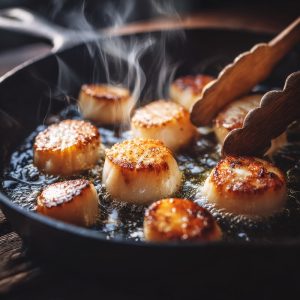
Scallops are lean protein, and as such, they can toughen very easily upon cooking.  It is very important not to overcook scallops as they can go from succulent to rubber ball pretty quickly.  Don’t take your eyes off them when cooking to make sure that you remove them from the heat when they are still moist, juicy and plump.

Grilling, sautéing, broiling and grilling are all simple, dry heat methods by which you can cook large sea scallops to really showcase them.  Moist heat methods including stir-fry (with sauce) and simmering (as in soups and stews and even risottos) are perfect for the small, sweet bay scallops.

Below are some of my favorite scallop recipes:

Related Topics:

Sauteed Sea Scallops On Grilled Pineapple Recipe

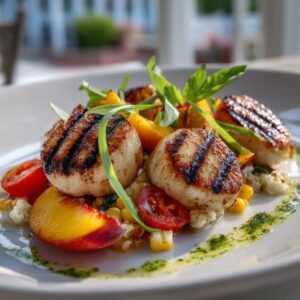
Grilled Scallops & Nectarines with Fresh Corn and Jersey Tomato Salad

Sea Scallops with Tomato Ginger Vinaigrette


Pan Fried Flounder with Potatoes and Parsley

October 22nd, 2010 by RG in Seafood Recipes

Pan-fried Flounder with Parsley and Lemon

Photo Credit: The Scandinavian Cookbook

Yesterday, I posted an interview with Danish celebrity chef and cookbook author Trina Hahnemann about her new cookbook, The Scandinavian Cookbook, as well as how to be a better home cook.  It is a wonderful read with some great tips on how to approach cooking in your own personal way. The interview covers a lot of ground so I suggest you check out my Interview with Trina Hahnemann.

One of the recipes I fondly remember my Danish mom cooking is Pan-fried Flounder with Potatoes and Parsley. My dad would grow red potatoes in his garden and just before dinner go out and dig up some young ones we called new potatoes. Because the skin is thinner than what you find on older potatoes, they were seldom peeled.

My mom would boil them until tender and serve them with pan-fried flounder. Some weekends down at the Jersey shore when the Barnegat Bay was full of flounder, we would enjoy fresh, hour-old fish after going out on my Uncle Walt’s boat. I like Trina’s method of preparing the potatoes better than my mom’s (but I wouldn’t admit that to my mom).

Pan-fried Flounder with Potatoes in Parsley

Adapted from Trina Hahnemann’s The Scandinavian Cookbook

Ingredients:

  • 1 ¾ pounds fingerling potatoes (try new potatoes if you can find them)
  • Salt and pepper
  • 4 flounder filets
  • 1 cup all-purpose or rye flour
  • 9 tablespoons butter
  • ¼ cup minced fresh parsley

For Serving

  • 1 lemon, sliced
  • Dill Sprigs

Start by boiling the potatoes in a large pot of salted water. Remember to put the potatoes in cold water, let them come to a boil and cook until fork tender. Drain the potatoes and let them cool down, then peel them (or not if they are new potatoes).
Rinse the flounder under cold water and pat dry with a paper towel. Coat each flounder filet in flour being sure to shake off any excess flour or it will burn in the pan and make a mess.

Melt 5 tablespoons of the butter in a large skillet or fry pan big enough to hold all 4 flounder filets. If your pan is not big enough, use two pans or cook in batches. Pan-fry the fish for about 5 minutes on each side or until the filets are golden brown. If cooking in batches, be sure to keep the cooked filets warm while you finish the rest.

Here you can use another pan to finish the potatoes or remove the fish to a plate and keep warm. Add the remaining 4 tablespoons of butter to the pan, add the potatoes and sauté a minute or two.  Add the minced fresh parley and stir to coat.

Season with salt and pepper, to taste and serve immediately with the flounder topped with slices of lemon and dill sprigs.

This is so simple to prepare and extremely delicious especially if the potatoes and fish are ultra fresh.

Thank you Trina and I urge everyone to read my interview with Chef Hahnemann.


« Previous ArticleNext Article »
DON'T MISS ANY OF
MY BLOG POSTS
Enter your Email


Preview