Are They Roasted Potatoes or Baked Potatoes?
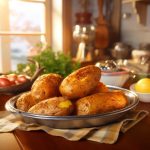
The distinction between roasted potatoes and baked potatoes comes down to both the cooking method and the intended result.
Roasted Potatoes are typically cut into chunks or wedges and cooked at a high temperature (around 375–425°F), usually uncovered to achieve a crispy, golden-brown exterior while keeping the inside tender. They are usually tossed in oil, herbs, and seasonings to enhance the caramelization and flavor. Roasting is a method used to develop a crispy texture and rich flavor through browning and caramelization. These are typically cooked on a lower or middle rack to ensure even cooking.
Baked Potatoes, on the other hand, are usually whole potatoes that are cooked at a moderate temperature(around 375°F), often with just a light coating of oil and salt. The goal is to cook the potato through until the inside is soft and fluffy. Baked potatoes are typically cooked directly on the oven rack or on a baking sheet and are not usually cut up. They can be baked for a longer time than roasted potatoes to ensure the interior becomes tender.
In short:
- Roasted Potatoes = Cut up, high heat, crispy exterior, golden brown.
- Baked Potatoes = Whole, moderate heat, soft and fluffy interior.
So, it depends on whether you’re roasting potato pieces for a crispy result or baking a whole potato for a fluffy interior!

58 Responses
Your article has been really helpful for understanding a product process. Thanks a lot
You are very welcome and thanks for visiting. – RG
I am truly happy that i subscribe to this site, it is so informative I am a home cook, I sometimes cook for small gatherings, what I’ve learned makes me feel like an iron chef, the difference between roasting and baking as you have explained I have asked other accomplished cooks and they couldn’t answer, some never thought about it, now they look at me as having a wealth of knowledge and come to me with some of their culinary problems. Thanks
Bless you! Yet yet another nice contribution, which is the reason I returned to all your blogging site time and again..
Excellent. Very comprehensive and well written. A must. Just found the site and will be exploring it extensively.
I am really enjoying your site. I have learned so much (even though I have been doing extensive baking and cooking for yrs.). Thanks again for the best and most informative site on the web. Liz
You are very welcome Liz.
Thanks for the information. I was troubled on how to explain baking and roasting to my participants next week until I found your answer… Arigatou, Marivic
Hi Marivic, who are you teaching? RG
So I wouldn’t bake a potato, I would roast it?
Stephen, I still say baked potatoes if they are whole and roasted potatoes if they are cut up, but what’s in a name?
and how come we ‘bake” a ham?
ooohh the joy of cooking!!
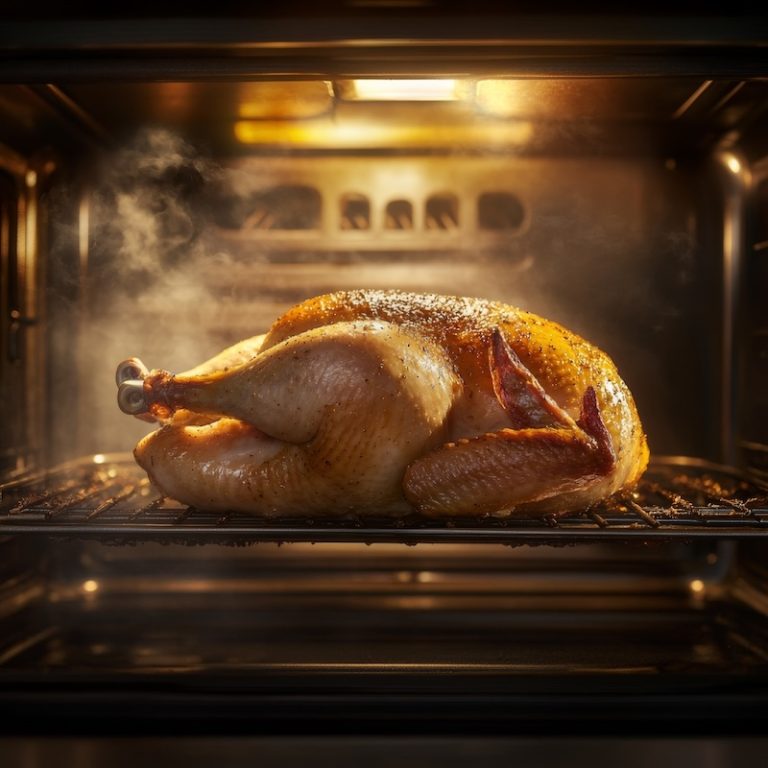
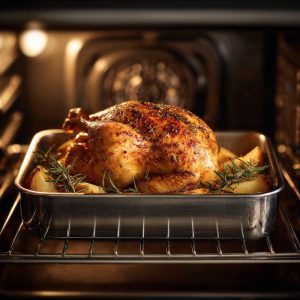
Hi Katie, and what about chicken? We’ve all enjoyed both baked and roasted chicken. – RG
In modern ovens there is a significant difference. When an oven has both baking and roasting settings, they are not interchangeable. When in the baking setting, the heat only originates from a bottom element. When set to roasting, the heating elements are both on the top and the bottom.
Hi Peter, interesting point. I think you find both those settings mostly on convection style ovens but I may be wrong. I just checked my brand new oven from LG and it only has baking and broil settings so I’m wondering if I’m missing an important feature. If I cook a chicken at 350 degrees F on the bake setting, I’m still going to call it roast chicken and the technique roasting and not baking. There is a very interesting article at http://www.ochef.com/1403.htm that describes the terminology and talks about various brands and how they define roasting/baking. I think what they say at the end of the article sums it up,
“You can see that accuracy in the semantic use of the words “roast” and “bake” has little meaning and consistency and certainly no advocates anymore. Even sticklers such as us have caught ourselves saying one when we meant the other. Sadly, this battle has been lost.”
I’m making baked potatoes and roasted veggies in the oven all at the same time!
Thanks for your informative post!
Beth, I love it. Isn’t it great we can do both at the same time?
Thank you, Peter – read 2 article and only found what I needed in your comment. Everybody writes what it’s for while missing to explain the actual difference in the way heat is applied.
So,if a recipe wants you to cover and seal completely, would it still matter? I mean, I get what you’re saying as far as cake goes,but what about people using a dutch oven for meats that have a heavy base and lid….with meats and veggies?
My oven’s heating elements at the top and bottom can be controlled. It is more of a analog oven and this is true. @Peter, spot on.
After seeing all kinds of foods described as “roasted”, like roasted garlic, roasted vegetables, just about everything but cake, and maybe ham, I have come to the conclusion that “roasted” is becoming a “drooler “word. I think it sounds more appealing than baked. But sometimes, I hear it and feel I am being played like Pavlov’s dog. When I see the term roasted garlic (baked garlic?) I imagine a bunch of cooks holding sticks with garlic on them over a campfire, roasting it, or roasting veggies on a spit over the same fire. Oh well, that’s just me.
Interesting take on the term Kay
After seeing all kinds of different things, I believe this website was the best by far! THANK YOU
I’m 76 years old. I recently saw a recipe for roasting eggplant cubes and wondered how different that might be from baking them! (One can still be ignorant and naive at 76.) Your rich explanation is superb and wonderful to read. I’ll be eating roasted eggplant cubes tomorrow. Thank you!
You are welcome, Alan, and keep cooking; it keeps you young.
So, if roasting usually occurs in an open pan, why do some roasting pans come with lids? ( I never know when to cover something or not unless otherwise specifically noted) I didn’t know the difference between roast/bake, when I googled it this is the first article, and thank goodness it was! Thank you!
Great question, Genevieve, and one I need to write an entire post about but to keep it simple, most roasting pans have how low sides and no cover, so the hot air can reach more of what you are cooking. The roasting pans with higher sides and a cover cook the food with steam rather than dry heat roasting. It’s a great way to cook some food, and I have friends who swear they are the best for cooking turkey. You could also use the high-sided – covered roasting pan for braising big batches of meat and chicken too. But if you want to roast using the dry heat method, I would stick with a low-sided roasting pan with no cover. – RG
I love the way it was explained. According to what i understood, roasting and baking is the same thing but you have to decide when to use one term or the other. I love it.
Thank you. Nice well explained article. I figured there was some difference, but obviously not enough that most regular ovens don’t come with a different sering other than bake and broil. I thought maybe a difference in the phan or method of dry/wet
Great article. First time I’ve been here but it’s a joy to find knowledge and food together in one place so I’m sure to be back.
My oven has both “”roast” and “bake” settings. My husband asked me which one to choose, so I came to your site. Interesting explanation and comments! I learned a lot! However, I wonder if the “roast” setting might automatically start out with a higher temperature (as you mentioned for a “crust”) and then automatically lower it??? I know that the “convection” setting automatically changes the temperature 25 -50 degrees lower than we actually set. Just a thought, not worth much.
nice site…
it is for the people who didn’t know the difference of baking to roasting…
nice site..
Clear and concise. No wonder your’s is the first google hit. Will be back.
thanks for your work
i wanna know the difference bewteen baking and roasting. You described so easily
from korea
nice site!
Thank you for letting me know.
The only really important difference between roasting and baking is knowing whether you are getting heat from both above and below or just below? The most annoying thing is that even the manufacturer doesn’t explain this and that’s all I really need to know. Keep it simple and leave the rest to the cook.
So, I guess that baking a with a covered pot would be called pot roast.
Best article I have found on the subject! We have a bake-off at work and only technical rule we have had is that items have to be baked in an oven. I would love to know your thoughts on other cooking methods. For example are crepes or pancakes considered baked or grilled? Thanks!
You are welcome, Lucy, and thanks for your kind words. I would consider making pancakes and crepes pan-fried because you are not cooking on a grill. However, if you use a griddle, could you call them grilled? Same with a “grilled” cheese sandwich. I make mine in a frying pan and not on a grill. Fun to think about.
Thanks for the excellent article contrasting these two cooking terms. It makes perfect sense to me, and resolves a long standing question.
Then what is the difference between a baked potato and roasting potato?
Some would say none, it’s just what you want to call them, but I think of baked potatoes as the large Idaho-style potatoes that are served individually and roasted potatoes as either pieces of potato or smaller fingerling potatoes that are coated with oil and roasted, but that’s just how I view them.
If roasting and baking are almost the same, why are there
different settings on a oven such as Bake, Roast,
Hi Richard, I have two ovens and I just looked and there are bake and broil buttons, no roast. Broil is different from roasting… the heat just comes from the top element but if you have a roasting button on your stove, please let me know the make and model and I’ll investigate. – RG
My definition of roasting would be when fat or oil is involved as a coating to achieve the characteristic caramelisation, eg Roasted chicken roasts in its own fat, roasted potatoes using oil.. Baking in when only a dry heat is used, eg baked potatoes, baked cakes etc, and braising is when meat or vegetables are cooked using a mixture of dry heat and liquid, ie a small amount of liquid in a covered dish in the oven (can also be called pot roast).
Casseroles, which are baked, not roasted, are not leavened. The word used commonly with each type of food is pretty much arbitrary.
This was a wonderful explanation. Thanks it totally clears it up for me so Thanks so much!
Nancy, you are very welcome.
This was very helpful. Now I understand the difference, even though I’d distinguished the two terms for many years!
When I took Home Economics back during the Pleistocene era, there was a difference between baking and roasting. Baking was done in the oven, and open ie. a cake or cookies. Roasting always meant the cover was put over top, as in a roast. The lid would often be taken off during the last short while, to help in the browning. If on the top of the stove, such as with a pot roast, the lid was kept on. So … baking = open to the heat; roasting = a cover over top.
Hi Valerie, what about a roast chicken or roasted turkey?
When my family roasts turkey, we cover with aluminum foil. I always thought roasting was in liquid.
No Artie, you may be thinking of stewing or braising but roasting is not done in liquid.
Thank you this article is very precise. Someone knows her onions. Nkiru, Nigeria.
This article was informative, but as others have mentioned, baking is not reserved to bakery items. The article doesn`t explain baked ham, chicken etc.
thanks for great info! came across this from ‘Smart Kitchen’ and thought you might be interested, with the confusion regarding modern ovens and their possible settings:
“Modern ovens, especially fancier ones, can have both Roast and Bake settings but there is no industry standard that states what exactly a Roast or Bake setting should do. In some cases “Bake” means only the bottom element is used and “Roast” means that both top and bottom elements are heated. In others the usage is reversed. They can also have Convection Roast and Convection Bake settings where convection heat is employed along with the heating elements. The point, is that there is no standard, so you will have to learn how your oven operates to use it to best effect. It is also not a bad idea, since many ovens don’t heat accurately, to Gauge the Cooking Temperatures of Your Oven using an oven-safe thermometer.”
Thanks, Katie for this information.
What about baked potatoes vs roast potatoes?
Hi Saira, really no difference but I think of whole potatoes being baked while potatoes cut into quarters as roasted but someone else may call it the exact opposite. Just preferences.
Thank the lord this article exists. I’ve spent 2 hrs looking for this information to get to the bottom of my question. I’m sure we all know the definition of what baking, roasting, broiling, etc means. But what other articles fail to do is explain to you the similarities and differences between cooking methods and how they apply to roasting, baking and broiling foods. Thanks for making this such an easy and uncomplicated article!!
You are welcome D.