Temperatures Are Important
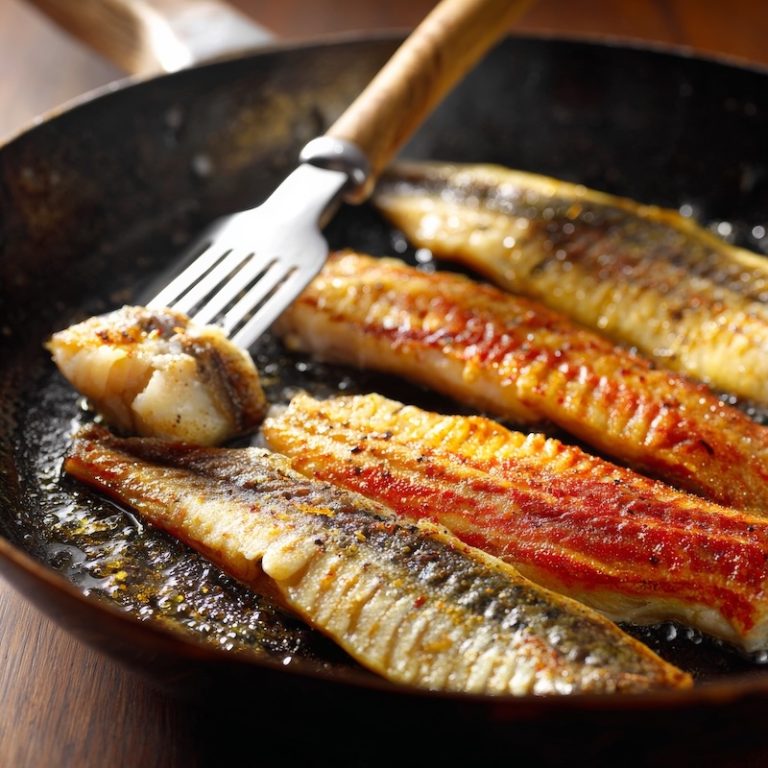
Temperature plays a huge role in keeping fish from sticking to the pan. If your pan isn’t hot enough, the fish won’t sear—it’ll steam.
That means the surface stays soft and wet, and those delicate proteins will latch onto the pan instead of forming a crust that naturally lifts away.
On the flip side, if the pan is too hot, the outside can burn before the fish cooks through. That scorched surface sticks too, and it can ruin both the flavor and texture.
The sweet spot is a medium-high heat. You want the pan hot enough that the oil shimmers but doesn’t smoke.
A good test: add a drop of water to the pan. If it sizzles and dances, it’s ready. Then add the oil, swirl it to coat the surface, and wait a few seconds before laying the fish down.
That initial blast of heat helps the fish form a light crust almost immediately. Once that crust forms, it acts as a natural barrier between the fish and the pan, which makes flipping easy and clean.
Bottom line? Get the heat right, and you’ll set yourself up for a perfect, non-stick sear every time.







46 Responses
My favorite method to keep fish from sticking is to have someone else cook it. Next best is deep frying.
I like seafood just fine, but have not had the best luck cooking it. Steak, pork, veggies … no problem, but fish is my bane … my Achilles heel … my white whale, as it were. (Oddly appropriate, n’est-ce pas?)
cooking fish is hard I think, so we almost never have any which is a mistake of cause, but sure looks good.
Hi, you’re great. You should make sure the meat or fish is dry or it will not cook properly.
Great advice Simran – RG
Thanks RG! I cooked catfish steaks over the weekend using these tips. It worked exactly as you said. At 3 minutes the fish didn’t release. 1 minute later it did with gentle lifting and without pulling my steaks to pieces. I love it when a plan comes together. Thanks again!
You are very welcome Kendal and thanks for letting us know about your results. – RG
I pan roasted $50 worth of sea bass for my mother-in-law’s 90th birthday last night. It was good, but it stuck to the pan. Now I know why, and I sure wish I had read this beforehand!
Thanks RG – just found your site and I’ll never try anything new again without checking with you!
Hi Margo, thanks for the kind words and sorry about the sea bass. Let me know how it turns out next time. – RG
I think brushing the oil/fat onto the fish is a mistake – you don’t know the temperature of the pan. Even if the water droplets evaporates, does the decent chef know what temps dictates the speed of evaporation? In addition, since you need at least 320 F, evaporating at 280 F does no good. Pour a thin layer of oil in the pan, slowly increase heat from low-med to med to med-high and wait for the first wisps of smoke…that’s the time to add the fish/meat – hot enough to sear yet not hot enough to burn the fat/oil. Obviously, don’t wait for plenty of smoke, because that might be too late. Now, if you want to brush fat/oil onto the fish in addition to oiling the pan, that’s another story. It goes without saying that you should know your smoke points, but most are within 50F of 400F.
Thank you.
Great points JM. Thanks – RG
I was told that I would know that the fish would not stick if I heated the oil in the pan until I would be able to “slide” a corner of the fish without it sticking…It has worked for me…and, yes, the fish needs to be dry and at room temperature.
Hi Carol, thanks for the tip. – RG
You may want to try adding some salt to the heated oil before putting the fish skin side first.
Very simple technique.
1. Heat pan.
2. Add oil and heat til almost smoking.
3. Add fish presentation side down.
4. Shake pan immediately.
5. Shake pan occasionally until fish starts to release.
6. Turn fish, shake, cook til done (or finish in oven).
Voila!
Sounds easy enough, but you would be surprised how many home cooks struggle with this. Thanks for sharing your technique Paul. – RG
I’d like to be able to shake my heavy cast iron pan without bubbling the fat all over myself but it’s scary. It’s good to know how chefs do it though.
Hey Barb, so would I. – RG
Paul is close, but no cigar. Steps 1, 2 and 3 are right on. But the rest are problematic. Don’t move the fish until you are ready to turn it over. Sticking is not a permanent process. With hot oil and no disturbance the fish will release itself. Watch the side of the fish pieces and turn when it is almost done. Cooking on the skin side will be quite brief. Squeezing fresh lemon on the fish with a bit of salt while it is skin down works well. Cast iron pan works well but with this technique stainless also works.
Hi Tom, thanks for your suggestions. – RG
Just caught up with your site. The next time I cook fish I will use your method. Something I dislike, terribly, is the white ooze that comes from salmon. I found that ten minutes in a brine helps to keep the protein where it belongs. Do you have another suggestion?
Hi Bill, thanks for the brining suggestion. I do not but I will ask around or maybe someone else has some ideas. – RG
I would lik to know how much salmon to serve 10 people
Hi Lucy, it really depends on who those 10 people are. Big eaters, dieters, kids, seniors? As a rule of thumb though, think 3/4 lb to 1 lb per person when serving a whole fish and 1/2 lb to 3/4 lb when dressed and cleaned and 1/3 lb to 1/2 lb when serving fillets or steaks.
What great advice you distilled for us, thanks for putting this together. I was sitting here after eating the red snapper which I cooked skin side down first, but tried moving it OVER AND OVER and needless to say the skin was not attached to the fish by the time i was done – I deglazed with vermouth after the fish was done and out of the pan and got the crispy skin onto my plate that way. But I will try your method next time and let you know!
Thanks to Google and your blog I hope I’ll get it right next time.
Hi Julia, let me know how it works out for you next time although it sounds like you saved a delicious meal with your quick thinking. – RG
I have seen somewhere on the web- on the science of protein not sticking, that as you heat the SS pan you want to finger flick droplets of water into it and you will see the various stages of readiness- going just beyond the water evaporating quickly, at the next stage the droplets roll and dance around in the pan- that is the point that the food will not stick- just brush in some oil and slide the fish in, lowering heat as not to burn.
Great points Carl. You may have seen this idea at my How Hot Should You Heat Your Pan When Sauteing? Thanks for bringing it up here. – RG
I’m an avid fisherman and only keep the fish I will eat. I’ve found that filleting a 1 to 5 lb fish with the scales/skin still on and grilling scale side down with a quick flip after seasoning to “sear” the up or meat side works great. Just eat the tender, seasoned fish out of the skin like a oyster out of a shell.
Hmmm Jerry, sounds delightful. – RG
My fish always flakes when I make it! Great post definitely a Bookmark – Jules
Whether the pan and the oil/butter/margarine are hot or not, dusting thoroughly dry fish with cornstarch will prevent it from sticking to the pan, and will form a light, golden crust on it.
I just used this technique and I’ve NEVER had a cleaner fish-cooking experience in my life. My pan looks immaculate; and compared to the usual 20 minutes that I need to spend scraping hardened fish particles off my pan, this is no less than a pre-Christmas miracle. Thanks so much!
You are very welcome and a Merry Christmas to you. – RG
Growing up my mother always cooked fish we caught as kids in a heavy cast iron pan and the crisp skin was always sought after…get yourself a heavy cast iron pan…bye George…(~.-)
my question is: “how do I remove the fishy oil out of the pan after cooking?”. Oil & water don’t mix, so there must be another way to clean the pan. Help!
Mika
I know this is Nov.2014 but if U happen to see this here is your answer.
Put about 1/2 to 2/3 cup of vinegar in the pan & bring to a boil & boil 3 to 5 minutes.
Let cool & U will have NO problems.
GOD bless
Hi Mika, how much oil are we talking about? Did you fry the fish or saute it? Usually I just use a paper towel to wipe out the pan of any residual oil and then wash it with soap and water. Oil and water don’t mix but a soap and water will clean the fish oil off the pan. – RG
I’m wondering if there are additional rules concerning different oils for white fish, v/s dark ones? Also, (since we’re talking sautes,) I usually dress my fish steaks in duxelles or salsa, which introduces additional problems, like when to add the obligatory splash of wine, and whether or not to marinate with fish sauce & herbs first, or to introduce those flavors in a separate sauce?
Nice one, my flounders were actually sticking in the pan when I “Googled” up your site, I quickly turned the heat up and left it to release itself and Bingo !, golden brown flounder intact. Thanks
I came across this article yesterday and tried it last night. Perfect.
Just discovered you..and thank you for the great details on pan searing and preventing fish from sticking. So I’m off to try the chilean seabass recipe. I’ll be back!
They are are really good tips but if I may! Can I add that if you have a nice big fillet you should slice the skin several times with a sharp knife. This is to prevent it from curling up.
That’s all 🙂
Very well written article. It not only tells what to do but why you are doing it.
The reason for cooking skin side down when cooking small pan fish is so they don’t curl up
Sorry error. Should have said skin side down first.
Sandy, I think it does.
I am trying this tomorrow with a large salmon filet. 🙂
Fingers crossed!
Generously spray PAM With Flour for Baking on grates. First time using it today and they were almost hard to keep from sliding off my smoker grill.
Your tips on keeping fish from sticking to the pan were a revelation to me, as I have been dealing with this problem for a while. Thanks so much.
You are very welcome Sharon.
My god, i ALMOST had a total meltdown today when my cod stuck to the pan, i should have read this article beforehand, thanks a lot!
Great info and comments here. Any tips for making sure the fish is dry enough (without pressing and/or using a roll of paper towels)? I get a lot of frozen wild caught fish and it is normally totally saturated when I take it out of the package. I have followed these tips with success (and thank you!) but the frozen fish not so much— seems to be my stcking point (!)
How about placing the fish in a colander and letting it drain for a while before patting dry with a paper towel?
Tried again and again and again and still always sticks to the pan until it burns. I’m just convinced at this point this is all nonsense.
Well that’s the first time I’ve cooked fish without it sticking and the first time I’ve gotten trout skin crispy on a skillet! Thank you very much for this fantastic post!
You are very welcome. Thanks for letting me know.
I grew up fishing brook trout. We would always set up a 12 inch cast iron over a cook fire and bring butter and oil with us. Trout would come out of the river, get cleaned and filleted and go right in the smoking pan. But the most important part of the cooking process was the heat of the pan. Skittering droplets that dance on the cast iron is what to look out for.
Thanks for the great write up!
Thanks Zackary for sharing your trout story. That’s how I have had trout several times and I remember how incredibly fresh everything tasted.