How to Fry an Egg Without Sticking or Breaking the Yolk

I've been cooking seriously for thirty years and I still break yolks. Not every time — but often enough that I've thought about why. The short answer is that I don't fry eggs every day. The cook at your local diner does. Repetition is the technique nobody writes about.

Fast Answer

Eggs stick when the pan isn't hot enough before the fat goes in, and yolks break when you flip too early or too hard. Get the pan temperature right, use enough fat, and don't walk away.

What the Diner Cook Knows That Most of Us Don't

There’s a diner near me where they ask how you want your eggs, and they come out exactly that way, every time. I’ve thought about why for years. It’s not a better pan or a secret technique — it’s repetition. That cook has fried more eggs before 9 am than most of us fry in a month.

What I’ve figured out in the meantime: two things matter most. Fat coverage in the pan, and attention. The second one sounds obvious until you’re making toast.

Start Here: What You're Actually Trying to Control

  • Who this is for: Anyone who's pulled an egg out of the pan with the white still stuck to it, a broken yolk, or rubbery edges they didn't want.
  • The real variables: Pan material, heat level, fat, and attention. That's the whole list.
  • What success looks like: Whites fully set with no translucent patches, yolk at the doneness you wanted, nothing stuck to the pan.
  • What this post covers: The mechanics first, then every major fried egg style with the specific cues that tell you it's working.

Why Pan Temperature and Fat Actually Matter

  • Eggs stick for a mechanical reason: Egg proteins bond to metal surfaces when heat is applied unevenly or too quickly. A properly preheated pan with adequate fat creates a barrier before the proteins have a chance to grab.
  • Fat does two things: It fills the microscopic pores in the pan surface, and it transfers heat more evenly than direct metal contact. Less sticking, more control.
  • Butter vs. oil isn't just about flavor: Butter contains water, which steams slightly as it cooks — this helps set the whites gently. Oil runs hotter and drier, which is why it produces crispier edges.
  • Why the diner cook doesn't think about this: Because they've done it enough times that the right heat and fat level is automatic. For the rest of us, it helps to understand what's actually happening.
Eggs Con Puntilla

Think Like a Cook: The One Idea Worth Taking Away

  • A fried egg is not a forgiving technique — it happens fast and waits for no one. The diner cook isn't more skilled than you; they're more present. Their attention never leaves the pan.
  • Once you understand that the egg is cooking from the moment it hits the pan and that heat keeps building even after you lower it, you stop multitasking. That's the actual technique.
  • The mental model: Treat every fried egg like it's the only thing on the stove. Because for the 2–3 minutes it takes, it is.

Step-by-Step: How to Fry an Egg

  • Step 1 — Choose your pan: Nonstick for ease and control, well-seasoned cast iron for flavor and crispy edges, stainless only if you know what you're doing with heat. The pan should be sized to the egg — too large and the fat spreads thin.
  • Step 2 — Preheat before the fat goes in: Set heat to medium or medium-low and let the pan sit for 60–90 seconds. Hold your hand a few inches above the surface — you should feel warmth radiating up. Don't rush this.
  • Step 3 — Add fat and watch it: For butter, wait until it melts and the foam subsides — that's your signal the pan is ready. For oil, wait until it shimmers and moves easily when you tilt the pan. If either starts smoking, the pan is too hot — pull it off the heat for 30 seconds.
  • Step 4 — Crack into a bowl first: Crack the egg into a small bowl or ramekin before it goes near the pan. This lets you remove shell fragments and slide the egg in gently rather than dropping it from height. It also keeps a broken yolk out of your pan.
  • Step 5 — Slide the egg in low and slow: Hold the bowl close to the pan surface and let the egg slide in. You should hear a steady sizzle — not a violent crack. If it spits aggressively, the heat is too high.
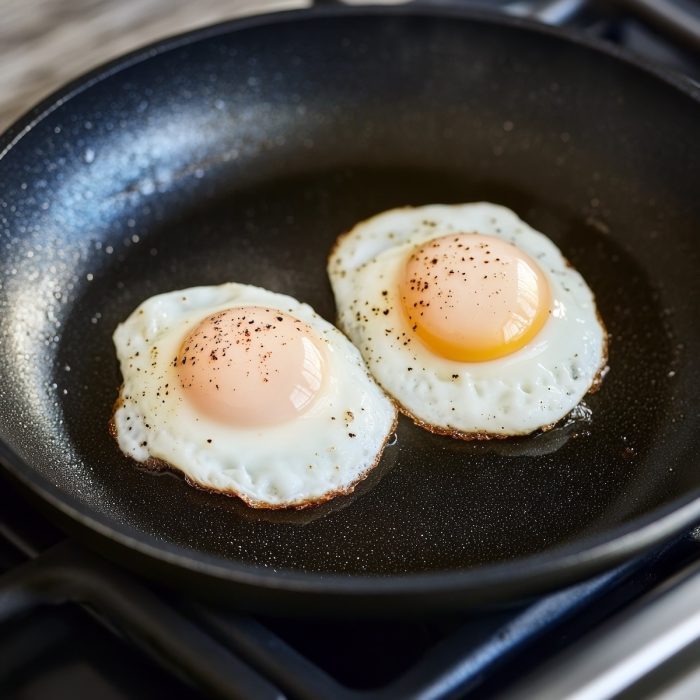
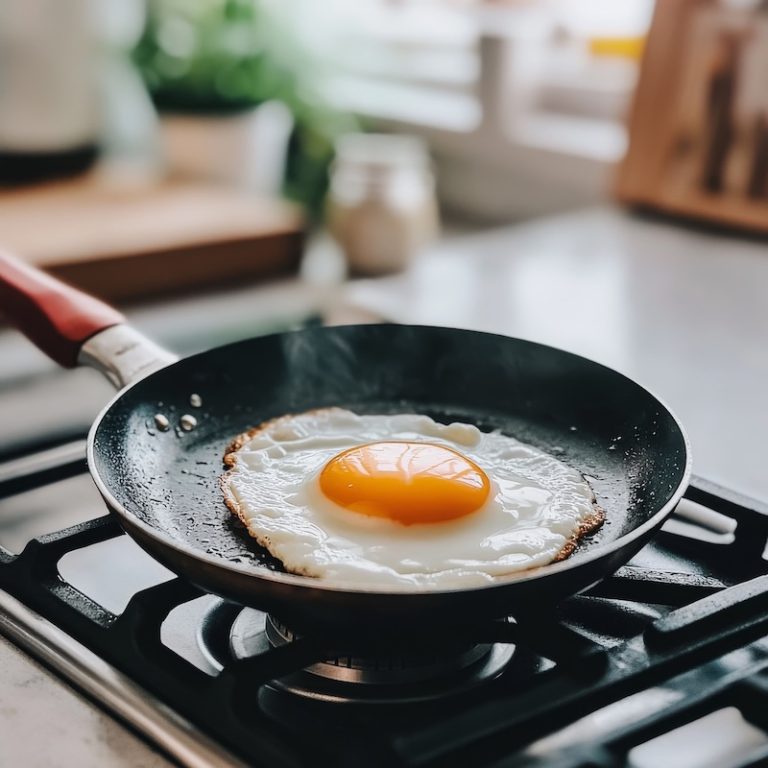
  • Step 6 — Don't touch it: Leave the egg alone until the whites are set around the edges and opaque most of the way through — about 2 minutes at medium-low. The yolk will still be completely raw at this point if you want it runny. That's correct.
  • Step 7 — Flip or finish: For sunny-side up, you're done when whites are fully set with no translucent patches. For over-easy through over-hard, slide a thin spatula fully under the egg before lifting — don't lever it up from one edge. Flip in one smooth motion, don't hesitate.
  • Step 8 — Time the yolk: After flipping — 10 to 15 seconds for over-easy (yolk jiggles freely), 30 to 45 seconds for over-medium (yolk gives slightly when pressed), 1 to 2 minutes for over-hard (no jiggle, press gently to flatten if needed).

Ways to Fry an Egg

Style Goal Heat & Fat What You'll See & Hear Timing
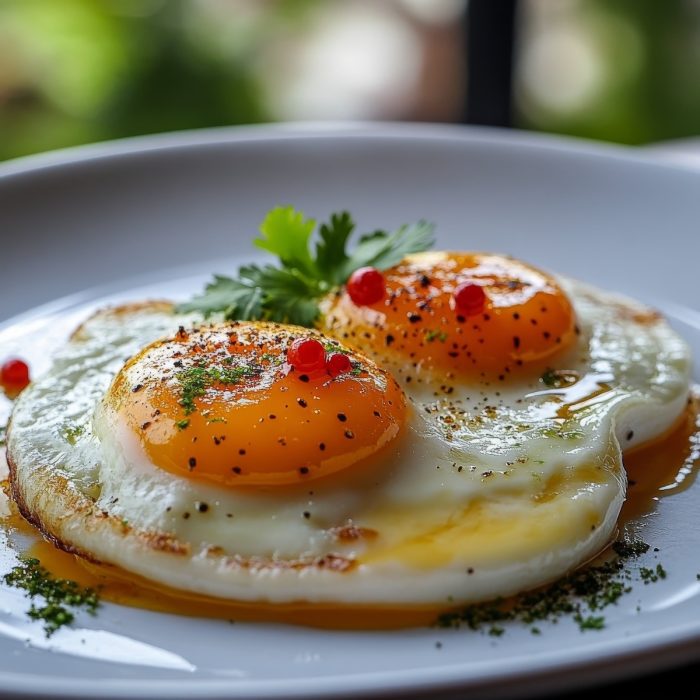
Sunny-Side Up Whites fully set, yolk liquid and glossy Medium-low / butter or oil Steady sizzle when egg hits pan; whites turn from clear to opaque from the outside in; yolk stays bright and jiggles freely 2–3 min, no flip
Over Easy Whites cooked through, yolk fully runny Medium-low / butter or oil Same as sunny-side; after flip, sizzle quiets almost immediately — that's your cue to pull it 2 min + 10–15 sec after flip
Over Medium Whites set, yolk jammy but not hard Medium-low / butter or oil After flip, press the yolk gently with your fingertip — it should give but not flow freely 2 min + 30–45 sec after flip
Over Hard Whites and yolk fully cooked through Medium / butter or oil After flip, yolk loses its dome shape and no longer jiggles; press lightly to flatten if needed 2 min + 1–2 min after flip
Basted Whites fully set, yolk soft — no flip Medium-low / butter Butter foams as you spoon it over; whites go from translucent to fully opaque under the hot fat 2–3 min, spoon fat continuously
Steam-Fried Soft whites, set yolk — no flip Medium-low / oil or butter Pan hisses sharply when water hits hot fat — cover immediately; whites cloud over within 60 seconds 1 min + 60–90 sec covered
Crispy / Lacy-Edged Crunchy golden edges, yolk to taste Medium-high / generous oil Loud sizzle and immediate bubbling around the edges when egg hits pan; edges frill and brown within 60 seconds 1–2 min, watch constantly
Spanish Style (Con Puntilla) Puffy whites, dramatic lacy edges, rich flavor High / generous olive oil Egg puffs almost immediately; oil should be shimmering and moving before egg goes in; whites blister within 30 seconds 30–60 sec, spoon oil over whites
French Style (Œuf au Plat) Silky, delicate whites; no browning Low / butter Butter melts slowly, no foam; whites set gradually with no color, no crisping, no sound beyond a faint whisper 3–4 min, tilt pan to baste
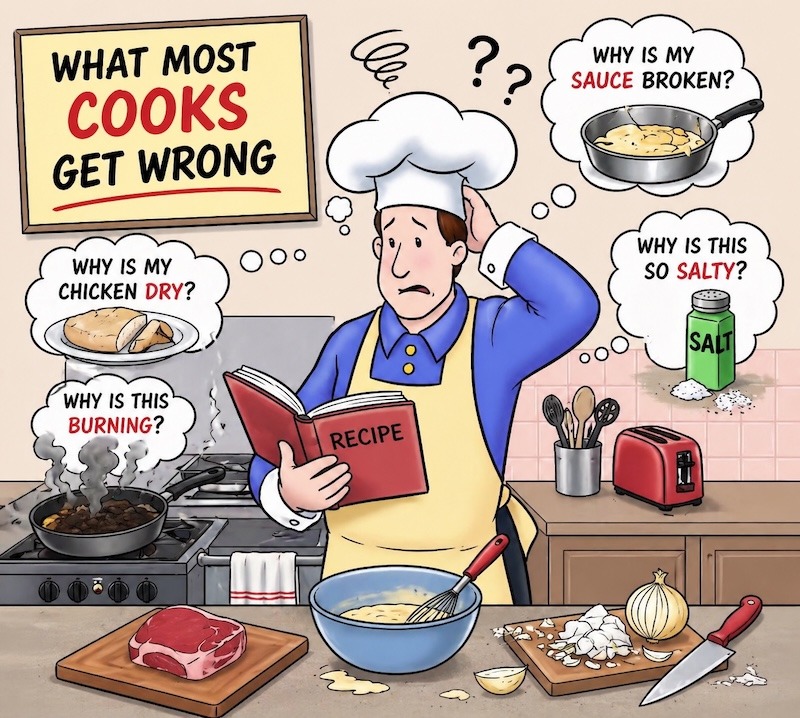
Frustrated cook making common mistakes.

What Most Cooks Get Wrong

  • They add fat to a cold pan: Fat needs a preheated surface to work properly. Added to a cold pan, it heats unevenly and the egg proteins bond to the metal before the barrier is established.
  • They flip too early: The egg looks done on top before it's ready to move. If the whites are still translucent around the yolk, the egg will tear when you try to slide the spatula under it.
  • They use too little fat: A thin film of butter or oil isn't enough. The entire base of the pan should be coated. More fat than feels necessary is usually about right.
  • They walk away: Two minutes is not a long time. But it's long enough for an egg to go from perfect to overcooked if you're making toast, checking your phone, or doing anything else. The egg doesn't wait.
  • They use too high a heat trying to speed it up: High heat sets the whites before the yolk has any chance to stay runny, rubberbands the edges, and makes sticking almost inevitable. Medium-low is slower and more forgiving on every count.

What Went Wrong — And Why

  • Egg stuck to the pan → pan wasn't hot enough before fat was added, or not enough fat → preheat longer, use more butter or oil, coat the entire base
  • Yolk broke during flipping → flipped too early before whites were fully set, or spatula wasn't fully under the egg → wait until whites are opaque, get the spatula all the way under before lifting
  • Whites rubbery or lacy when you didn't want them → heat too high → drop to medium-low and give it more time
  • Yolk came out harder than intended → cooked too long after flipping, or pan retained too much heat → time it precisely after the flip; remove from heat a few seconds early — carryover cooking finishes the job
  • Whites still translucent on top (sunny-side) → undercooked, pan too cool → add a few drops of water and cover with a lid for 30–60 seconds to steam the top
  • Egg spread too thin across the pan → pan too large for one egg, or egg was cracked from too high → use a smaller pan, crack into a bowl and slide in close to the surface
Eggs Over-Easy
Eggs Over-Easy

Control the Variables

  • Heat level → controls how fast the whites set and whether edges crisp or stay soft. Medium-low for tender whites and runny yolks; medium-high only if you want crispy, lacy edges deliberately. Most mistakes happen at too-high heat.
  • Fat quantity → controls sticking and edge texture. More fat means less sticking and more even cooking. A full coat of the pan base is the minimum; a tablespoon of butter for one egg is not excessive.
  • Fat type → butter steams gently and adds flavor; olive oil runs hotter and crisps edges; ghee or bacon fat adds savory depth without burning as quickly as butter. Neutral oils (canola, avocado) give you the most control with the least flavor input.
  • Pan material → nonstick forgives heat errors; cast iron holds heat longer and can cause overcooking if you're not paying attention; stainless requires more fat and more precise temperature.
  • Pan size → an 8-inch pan for one or two eggs keeps the fat concentrated and the egg compact. A 12-inch pan spreads the egg thin and the fat thinner.
  • Lid → covering the pan traps steam and cooks the top of the egg without flipping. Useful for sunny-side up with fully set whites. A glass lid lets you watch without lifting it.

When to Fry — and When Not To

  • Use it when: You want distinct whites and yolk, any level of yolk doneness from runny to fully set, or crispy edges. Also when you're topping something — a burger, a grain bowl, avocado toast — and the egg needs to hold its shape.
  • Use it when you have two free minutes: That's genuinely all it takes, but they need to be uninterrupted minutes. If something else on the stove needs attention at the same time, finish that first.
  • Skip it when: You want a uniform texture throughout — that's scrambled eggs. Or when you're cooking for a crowd — fried eggs don't hold well and can't be done in large batches without serious equipment.
  • Skip it when you're distracted: This sounds like a joke. It isn't. If something else is competing for your attention, make scrambled eggs instead. They're more forgiving.

Apply It to Real Food

  • On toast or avocado toast: Over-easy is the right call — the yolk breaks when you cut into it and acts as a sauce. Time the flip precisely; 10 seconds too long and you've lost the point.
  • On a burger: Over-medium holds together better than over-easy when it's going on top of a patty. A fully runny yolk tends to slide off before the first bite.
  • On a grain bowl or rice: Sunny-side up works well here — the yolk mixes into the grains as you eat. Use olive oil rather than butter; it stands up better to the other flavors.
  • With bacon fat in the pan: This is worth doing at least once. Fry your bacon first, leave a tablespoon of fat in the pan, and cook the egg in it. The whites pick up the smokiness. No other changes needed.
  • Spanish-style (con puntilla) with good olive oil: More oil than feels reasonable, very hot but not smoking, egg slides in and puffs within seconds. Spoon hot oil over the whites as they set. The result is nothing like a standard fried egg — crispy, airy edges and a barely-set yolk. Worth the extra olive oil.

Fried Egg FAQ

How do you fry an egg without it sticking to the pan?
Preheat the pan before adding the fat — this is the step most people skip. Once the pan is warm, add enough butter or oil to coat the entire base, wait until it’s ready (the butter foam subsides, the oil shimmers), then add the egg. A cold pan with fat added too early is the most common reason eggs stick.

What’s the difference between sunny-side up, over-easy, over-medium, and over-hard?
Sunny-side up isn’t flipped — whites set, yolk stays fully liquid. Over-easy is flipped once with about 10–15 seconds on the second side, yolk still runny. Over-medium gets 30–45 seconds after flipping, yolk is jammy but not fully set. Over-hard goes a full minute or more, yolk cooked through. The flip is the same in all three cases — only the time after it changes.

What pan is best for frying eggs?
A nonstick skillet is the most forgiving — requiring less fat, easier to flip, and more tolerant of heat mistakes. A well-seasoned cast-iron pan works well if it’s properly maintained and you’re comfortable with its heat retention. Stainless steel can be done but requires precise temperature control and more fat. For most home cooks, nonstick is the right tool.

Why do my egg whites turn rubbery?
Heat too high, almost always. High heat sets the proteins in the whites too fast, squeezing out moisture and leaving a tough texture. Drop to medium-low and give it an extra minute — the whites will be tender and fully set without the rubber.

How much butter or oil should you use?
More than you think. The entire base of the pan should be coated, not just the center. For a standard 8-inch pan and one or two eggs, a full teaspoon of butter or oil is a minimum — a tablespoon is not unreasonable. Thin fat coverage is one of the main reasons eggs stick and cook unevenly.

How do you keep the yolk from breaking when you flip?
Two things: wait until the whites are fully set before you attempt the flip, and get the spatula completely under the egg before you lift. Levering up from one edge almost always breaks the yolk. A thin, flexible spatula helps more than a thick one.

Can you fry an egg without flipping it and still get fully set whites?
Yes. Add a few drops of water to the pan after the egg goes in and cover immediately with a lid — the steam cooks the top without flipping. Check after 60–90 seconds. This is how basted eggs work, and it’s a useful technique when you want sunny-side presentation with no translucent white.

Why does the diner always get it right and I don’t?
Repetition, mostly. A short-order cook fries dozens of eggs every morning — the right heat level and fat amount become automatic. At home, most of us fry eggs occasionally and have to relearn the feel of it each time. Understanding the mechanics helps, but the honest answer is that it gets easier the more you do it.

What fat gives the best flavor for fried eggs?
Butter is the classic answer and it’s hard to argue with — it adds richness and the milk solids brown slightly at the edges. Bacon fat is worth trying if you have it. Olive oil gives a different flavor profile and crisper edges. For neutral flavor with maximum crispiness, avocado oil or another high-smoke-point oil works well.

Does the egg carton matter — does egg quality affect how a fried egg turns out?
It does, more than most people expect. A fresh, high-quality egg has a thick white that stays compact in the pan rather than spreading thin. An older egg spreads more and cooks less evenly. If you’ve ever had an egg run to the edges of the pan before you could do anything about it, the egg’s age was probably a factor.

Leave a Reply

Your email address will not be published. Required fields are marked *

This site uses Akismet to reduce spam. Learn how your comment data is processed.