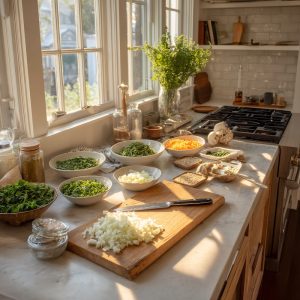

This Is How You Make Restaurant Quality Demi Glace

Want to cook like a pro? It starts with demi-glace—the rich, glossy sauce that turns “pretty good” into “restaurant-level.” Yes, it takes time, but so does anything worth bragging about. Master this kitchen power move, and your sauces will never be basic again.

Why Home Cooks Should Make Demi-Glace

  • Depth of flavor: Homemade demi-glace delivers richer, more nuanced taste than store-bought sauces.
  • Control ingredients & quality: Know exactly what goes into your sauce—no preservatives or hidden additives.
  • Maximize kitchen efficiency: Make a batch and freeze portions to elevate weeknight dinners instantly.
  • Boost meal presentation & experience: A glossy, rich sauce visually and emotionally elevates any dish.
  • Surprise & impress guests: Homemade demi-glace shows care and craft, turning ordinary meals into gourmet experiences.
  • Increase umami in dishes: Adds depth naturally, so you can reduce salt or heavy seasoning while keeping bold flavor.

What is Demi Glace?

Demi-glace transforms everyday meals into restaurant-quality dishes. Rich, glossy, and packed with umami, it elevates steaks, roasts, and sauces with depth you can taste in every bite.

Making it at home may seem daunting, but with step-by-step guidance, you’ll gain confidence, sharpen your sauce-making skills, and unlock endless culinary possibilities. This guide shows you how to create, use, and store demi-glace while saving time and maximizing flavor.

Classic Demi Glace Recipe

How to make a restaurant quality demi glace at home.
Prep Time45 minutes
Cook Time7 hours
Total Time7 hours 45 minutes
Course: Sauces
Cuisine: French
Keyword: demi glace, sauce
Servings: 1 gallon

Ingredients

For the Brown Stock

  • 8 pounds veal marrow bones sawed into 2-inch pieces
  • 6 pounds beef marrow bones sawed into 2-inch pieces
  • 16 ounces tomato paste
  • 4 cups chopped onions
  • 2 cups chopped carrot
  • 2 cups chopped celery
  • 4 cups dry red wine
  • 1 bouquet garni
  • Salt and pepper
  • 16 quarts of water

For the Espagnole Sauce

For the Demi Glace

  • 1 gallon Espagnole sauce hot
  • 1 gallon brown stock hot
  • 1 bouquet garni

Instructions

To Make the Brown Stock

  • Preheat the oven to 450 degrees F. Place the bones in a roasting pan and roast for 1 hour. Remove the bones from the oven and brush with the tomato paste.
  • In a mixing bowl, combine the onions, carrots, and celery together. Lay the vegetables over the bones and return to the oven. Roast for 30 minutes. Remove from the oven and drain off any fat.
  • Place the roasting pan on the stove and deglaze the pan with the red wine, using a wooden spoon, scraping the bottom of the pan for browned particles. Put everything into a large stockpot. Add the bouquet garni and season with salt.
  • Add the water. Bring the liquid up to a boil and reduce to a simmer. Simmer the stock for 4 hours, skimming regularly. Remove from the heat and strain through a China cap or tightly meshed strainer.

Yield: about 2 gallons

    To Make the Espagnole Sauce

    • In a stock pot, whisk the hot stock into the roux.
    • In a large sauté pan, heat the bacon fat. Add the vegetables. Season with salt and pepper. Sauté until wilted, about 5 minutes.
    • Stir the tomato puree into the vegetables and cook for about 5 minutes.
    • Add the tomato/vegetable mixture to the stock/roux mixture.
    • Add the bouquet garni and continue to simmer, skimming as needed. Season with salt and pepper.
    • Simmer the sauce for about 45 minutes. Strain the sauce through a China cap or tightly meshed strainer.

    Yield: 1 gallon

      To Make the Demi Glace

      • In a stock pot, combine the Espagnole sauce, brown stock and bouquet garni, together, over medium-high heat.
      • Bring up to a boil, reduce the heat to medium and a simmer until the liquid reduces by half, about 1 1/2 hours. Skim the liquid occasionally, for impurities. Season with salt and pepper.
      • Strain through a China Cap or tightly meshed strainer.
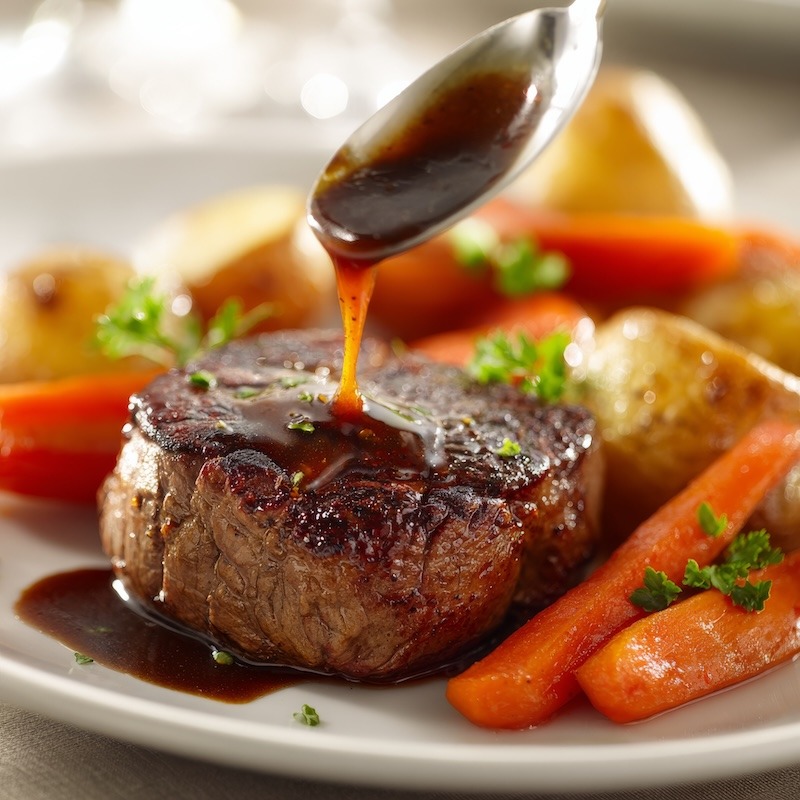
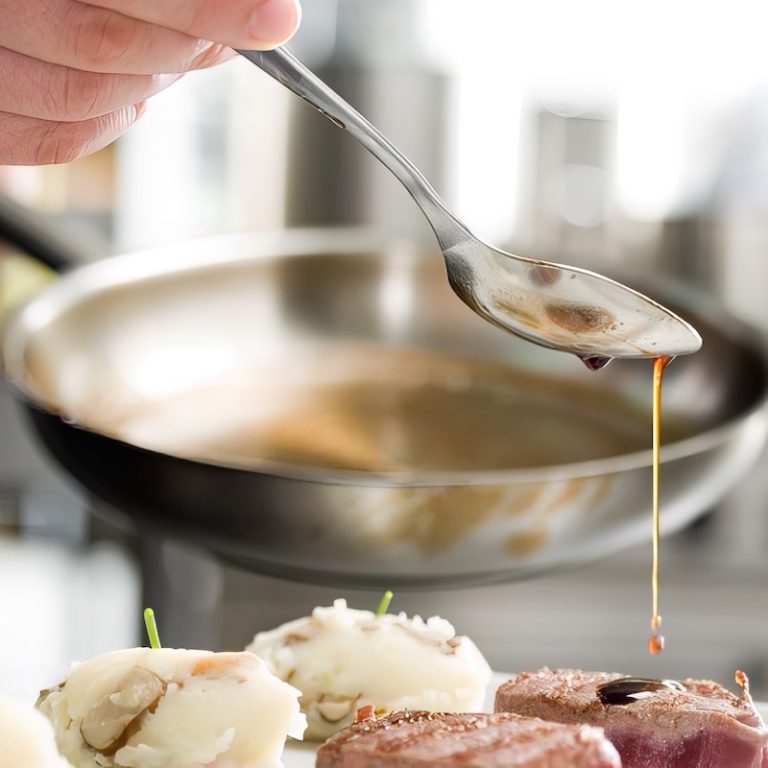
      A perfectly cooked filet mignon steak on a white plate, served with glossy demi-glace
      A perfectly cooked filet mignon steak on a white plate, served with glossy demi-glace

      Step By Step

      Step Description
      Prepare the Brown Stock Roast beef or veal bones with aromatic vegetables, then simmer them slowly with water, herbs, and tomato paste for several hours to extract deep, rich flavor.
      Make Espagnole Sauce Cook a dark roux with butter and flour, then add brown stock, tomato paste, and mirepoix. Simmer until thickened and flavorful, forming the base sauce.
      Reduce the Mixture Combine equal parts brown stock and Espagnole sauce, then simmer gently until the liquid reduces by half, developing a glossy, concentrated consistency.
      Strain and Store Strain the sauce through a fine mesh sieve or cheesecloth to remove solids. Cool and store in airtight containers or freeze in portions for future use.
      Optional: Add Finishing Touches Add a splash of wine, a pat of butter, or fresh herbs for extra depth and aroma, depending on how you plan to use the demi-glace.

      Healthful Tips

      Tip Description
      Use High-Quality Ingredients Start with high-quality bones, ideally veal or beef, and fresh vegetables. The better your ingredients, the richer your final sauce will be.
      Roast the Bones for Deeper Flavor Roasting the bones before simmering adds a rich, caramelized flavor to the stock, enhancing the demi-glace’s overall taste.
      Simmer, Don’t Boil Keep the stock at a gentle simmer throughout the process. Boiling can make the stock cloudy and prevent the flavors from developing properly.
      Skim Regularly Skim off any impurities, foam, or fat that rise to the surface while simmering to keep the stock clear and ensure a smooth texture for your demi-glace.
      Patience is Key Making demi-glace requires time. Simmer your stock for 6–8 hours and allow the final mixture to reduce slowly to develop its complex flavors.
      Strain Thoroughly Use a fine mesh sieve or cheesecloth to strain the stock and sauce. This will result in a smooth, velvety consistency.
      Avoid Over-Seasoning Early On Don’t add too much salt during the early stages, as the sauce reduces and concentrates the flavors. Add any seasoning toward the end, if needed.
      Use Ice Cube Trays for Storage Once your demi-glace is made, freeze it in ice cube trays for easy portioning. This allows you to use small amounts whenever needed.
      Consider Adding Wine Adding a splash of red wine or Madeira can bring additional complexity to the demi-glace during the reduction stage.
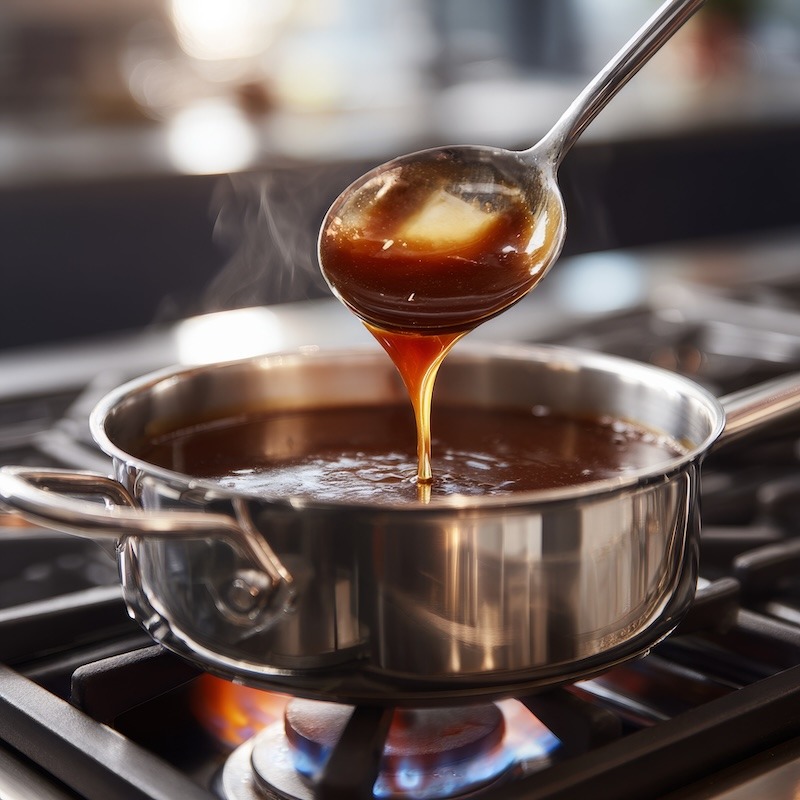
      Consistency is Key Demi-glace should be thick enough to coat the back of a spoon. Keep reducing until it reaches this consistency, but don’t let it burn or become too thick.

      Commercial Demi-Glace

      Top Pick: With More Than Gourmet's Demi Glace Gold gone, Bonewerks Culinarte Demi Glace de Veau Classic is the closest commercial alternative.

      Rich & Velvety: Made from carefully simmered beef and veal bones, it captures the essence of slow-cooked meat. Glossy texture adds depth to pan sauces, stews, and braises.

      Versatile & Savory: Concentrated flavor enhances dishes without overpowering other ingredients. Perfect for reductions, meats, and vegetables.

      Convenient & Time-Saving: Delivers restaurant-quality results at home, saving hours of traditional preparation.

      Availability: Amazon sells 2-pound containers, while some local supermarkets carry 1-pound options. Pricey, but worth it for quality.

      🛒 Check Prices for Bonewerks Demi Glace on Amazon

      Available on Amazon

      Pan Sauces

      Demi-Glace FAQ

      What is demi-glace?
      Demi-glace is a rich, deeply flavored brown sauce made by reducing brown stock and Espagnole sauce by half. It serves as a foundation for classic French sauces and pan sauces.

      What ingredients are in traditional demi-glace?
      Typically veal or beef stock, brown roux (flour and butter), aromatics (onion, carrot, celery, tomato paste), and seasoning. Wine or additional herbs may be added for flavor variations.

      How long does it take to make demi-glace?
      Traditional demi-glace can take several hours due to stock simmering and reduction. Using shortcuts like pre-made stock or partial reductions can shorten the process to 1–2 hours.

      Can I make demi-glace ahead of time?
      Yes. Make a batch and refrigerate for up to a week, or freeze in portions for months. Thaw gently before reheating.

      What are common shortcuts for home cooks?

      • Use high-quality store-bought brown stock
      • Make a half batch of Espagnole sauce
      • Reduce the sauce to demi-glace in smaller portions
        These shortcuts still deliver flavor while saving time.


      How do I store demi-glace?

      Refrigerate in an airtight container for up to 7 days. Freeze in small portions, such as ice cube trays, for easy use later.

      Can I use demi-glace in everyday cooking?
      Absolutely. It’s versatile: pan sauces, stews, roasted meats, vegetables, and even pasta dishes benefit from demi-glace’s depth.

      How do I reheat demi-glace without breaking it?
      Warm gently over low heat, stirring frequently. Avoid boiling, as it can separate the sauce and alter its texture.

      What’s the difference between demi-glace and brown gravy?
      Demi-glace is a concentrated, refined sauce made from stock and Espagnole, while brown gravy is usually flour-thickened and simpler in flavor.

      1Can I make demi-glace with other proteins?
      Yes. While traditional recipes use veal or beef, chicken, turkey, or even mushroom stock can create variations for lighter sauces.

      How do I thicken demi-glace if it’s too thin?
      Simmer gently to reduce further, or whisk in a small amount of butter (mounting with butter) at the end to enrich the texture.

      Can I add wine or other flavors to demi-glace?
      Yes. Red wine, Madeira, brandy, or mushroom reductions are commonly added to enhance depth. Add during reduction for integration.

      Is demi-glace difficult for beginners?
      It requires patience, but following step-by-step instructions makes it approachable. Shortcuts and pre-made stocks simplify the process.

      What are common mistakes to avoid?

      • Boiling instead of gentle simmering
      • Not skimming impurities from stock
      • Over-reducing or under-reducing
      • Using low-quality ingredients


      How do I use demi-glace to make pan sauces?

      After cooking meat, deglaze the pan with wine or stock, add demi-glace, reduce to the desired consistency, and finish with butter or cream if desired.

      Demi Glace History

      Demi-glace has its roots in classic French cuisine, where sauces play an essential role in elevating the flavor and presentation of dishes. The term “demi-glace” itself comes from the French words “demi,” meaning half, and “glace,” meaning ice or glaze. It refers to the sauce’s reduction process that transforms it into a concentrated, glossy glaze.

      The creation of demi-glace is closely linked to the development of French haute cuisine in the 17th and 18th centuries, mainly through the influence of French chef Antonin Carême, considered one of the founding fathers of modern French cooking. Carême revolutionized the way sauces were made, simplifying and systematizing them.

      He introduced the concept of “mother sauces,” from which many other sauces could be derived. Espagnole, one of these mother sauces, is the precursor to demi-glace.

      Later, Auguste Escoffier, another legendary French chef, refined Carême’s techniques in the late 19th and early 20th centuries, further perfecting the method of making demi-glace. Escoffier’s version was more accessible, becoming a staple in French kitchens and a foundation for many classic French dishes.

      Today, demi-glace continues to be revered for its ability to enhance flavors, making it an iconic element of French gastronomy.

      30 Responses

      1. This is a “rehash” of Emeril’s recipe. However, if you follow Emeril’s recipe, you don’t get enough brown sauce to construct the finished product. The yield in this recipe is just right and also what is necessary to end up with the desired amount of finished product. Also, veal bones are very hard to acquire outside of the commercial market. Lastly, you don’t have to use all the tomato paste.

        I like the recipe and unlike Sokolov’s process, it does not take two days to complete.

        1. This recipe is in the French tradition and developed several hundred years ago, not Emeril. The recipe is fairly basic. The reason for the veal bones and the beef bones ‘is to give’ you give you two different types of marrow. I like to cook mine with the knuckles. You can see both recipes work off the beef stock ‘with one’ reduced down with a few more spices for the Espanol and then again demi glace. Espanol is used as a base for Soups and demi glace used for sauces. That’s how I use it but the notion that this recipe is a rehash Emeril Lagasse recipe, you should probably read the origins of the sauce. In fact, the rest of the four mother sauces also ‘use’ these recipes ‘and’ have been being married for so long. People have been making the sauces for so long they tend to forget why the original sauce was made to exacting standards right down to weight.

          1. 3 stars
            this recipe is not the standard Escoffier recipe.
            You need to take the bone broth and cook been meat in it ie shank meat.
            Each time, reducing the liquid to an almost glaze like consistency.
            The shank meat is essentially useless after that since all the nutrients and flavors have gone into the glaze,

      2. 5 stars
        Making demi-glace is a long process but it’s worth it. I save my bones in my freezer as I get them. As long as they are beef bones I’m happy. The reducing part is the longest part. I’ll add some madiera wine to my stock as I go. You don’t end up with much when you are done but you don’t need a lot a make a sauce. I freeze it in small containers until I need it.

      3. I am having trouble finding cheap organic stock bones. This recipe calls for 14lbs bones (6ish kg), prices vary from £2 per kg to over £5,JUST FOR BONES! I am looking for £1 per kg but cannot find such a price.

        1. You can scale this recipe to a smaller quantity. A gallon of Demi a a restaurant quantity. A liter, about 1/4 whats shown in this method would work well for a home kitchen. Some folks argue that making less than a gallon results in a poorer flavor. There’s no physical or rational justification for that claim and in my experience it’s just not true.

      4. I like to use veal tail. Pretty incredible how much collagen is in one tail. Cut the final product with a knife!

      5. I am trying this recipe again and I am not getting a dark brown colour in my Demi glaze.it more beige or light brown What are the keys to getting a dark brown Demi glacé?

        1. I recommend a black jack -sugar and water brought past 360 degrees carefully as water once sugar is dark and use that to colour your demi

          1. Kitchen Bouquet or even Gravy magic , Maggie.. all will add a darkening to the sauce without changing the flavor much . The way you are supposed to get the darkened color is from roasting the bones and mirepoix in the oven

        2. Your roux is not dark enough. You’ve got to cook the roux to a dark brown but not burnt stage. The bones must be roasted well also. If not lacking in these two things will shift the entire end product as stated to a light brown weak demi.

          1. Yes, Kevin, this is correct. Without roasting the bones properly and cooking the roux until it is dark but not burned the proper color and flavor will not be achieved. If these two steps are not performed properly the color and flavor will be weak and the ingredients and time will be practically wasted.

        3. 5 stars
          One trick for natural color and flavor is to coat your onions and bones with tomato paste; the technical name in French cooking for this is “pince”. This is one aspect of the procedures I do differently than the suggested manner. I coat all the bones and onions right from the start with tomato paste, the onions I quarter instead of dicing or chopping. I do this regardless when making beef stock which is the start of this process to yield demi eventually. You get natural flavor and natural coloring by adding non-traditional ingredients.

        4. Personally I brown the bones and the veges in high heat in the oven 180°10-15 min then 220° 5-8 min this is for the bones mostly.for the veges 180°10 min is enough.then when you put the both bone n veges in stock pot,add tomatoes paste and cook until the paste produces red colour oil(sautee the bone,veges and paste)add flour and continue to cook dill the flour starts to stick to stock pot,then add water n let boil and reduce heat simmer

        5. The reason your Demi glacé is to light because you don’t cook your bones and vegetables long enough to get darker colors, then your Roux it’s not dark enough, you should place the roasting pan on stove-top medium high, will cover 2 burners, let it cook brown bits , darker color will give you mor color and flavored before you deglaze it with wine or water.

        6. Some random thoughts
          Browning your tomato puree -frying it
          Browning your roux well
          Make sure your onions are almost charred.
          Make sure your bones are well roasted- I will use a convection setting toward the end

        1. Good thing you didn’t see what my neighbor was doing to the poor grass in his yard this morning! He was mowing it! That was disgusting! There should be a law against that!

      6. If this is being used for demi-glace the salting should only take place during the reduction phase, because any tasting that detects salt prior to reduction means the final product will come out twice as salty.

      7. If you live anywhere in the states there is probably a Hispanic part of town in your city. In that part of the city you will find a Hispanic bodega with a meat counter. I have found that they will give you the bones for free as they see no value in the bones since their clients don’t buy bones. To them the bones are trash.

        They typically also have great cuts of meat. I always buy my other ingredients from them since they give me the bones for free.

      8. I used to buy my demi glace for home use from a restaurant in Chicago. Outstanding sauce. About 5+ years ago they sold out and the new restaurant no longer made it available Would you please put me on your mailing when you have completed your look at available alternatives?

        Don Dickson

        1. Hi Don, I’m on my last puck of More Than Gourmet’s Demi-Glace Gold, so I will need to find a good alternate. I will let you know when I find one I like and compare quality to cost.

      Leave a Reply

      Your email address will not be published. Required fields are marked *

      Recipe Rating


      This site uses Akismet to reduce spam. Learn how your comment data is processed.