

You find a recipe calling for fresh basil and all you have is dried. Do you swap it? How much? Get it wrong and your dish either tastes flat or wildly overpowering. I've made both mistakes — this guide gives you the exact ratios so you don't have to.
Fast Answer
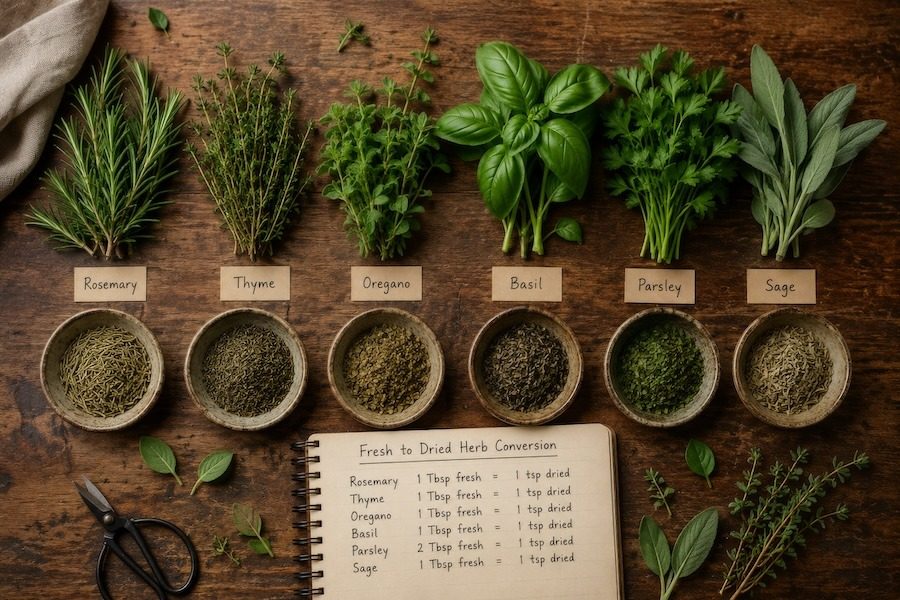
Most fresh-to-dried herb conversions follow a 3:1 ratio—use 1 teaspoon dried for every 1 tablespoon fresh. Adjust based on herb strength.
| Herb | Fresh → Dried | Best As |
|---|
| Herb | Fresh Amount | Dried Amount | Best Use | Notes |
|---|
Conversion Guide for the Most Common Herbs
Fresh Parsley to Dried Parsley
Parsley is the herb people ask about most — probably because it shows up in so many recipes as both a cooking ingredient and a finishing garnish, and the fresh and dried versions behave very differently.
The standard conversion is 1 tablespoon fresh parsley = 1 to 1½ teaspoons dried. Parsley is one of the few herbs where the ratio runs closer to 2:1 than 3:1 — dried parsley is weaker than most dried herbs, so you need a little more of it to get the same effect.
The honest truth about dried parsley is that it’s a compromise. It adds color and a mild herby note to cooked dishes — soups, stews, sauces — but it loses the fresh, grassy brightness that makes fresh parsley worth using as a garnish. If a recipe uses parsley as a finishing herb, scattered over a finished dish, dried parsley won’t do the same job. Use it in cooking, not as a garnish.
Quick reference:
- ¼ cup fresh parsley = about 4 teaspoons dried
- ½ cup fresh parsley = about 8 teaspoons (2 tablespoons + 2 teaspoons) dried
- 1 cup fresh parsley = about 5 tablespoons dried
Fresh Thyme to Dried Thyme
Thyme is one of the best herbs to use dried — it holds up exceptionally well during drying and, in some applications, actually develops a deeper, more complex flavor than fresh.
The conversion is 1 tablespoon fresh thyme = 1 teaspoon dried thyme — the standard 3:1 ratio. Unlike parsley, this one holds true reliably across most recipes.
Add dried thyme early in the cooking process — it needs time in heat to bloom and release its flavor. Fresh thyme added at the end of cooking will give you a brighter, more delicate result. Both are valid approaches depending on what you’re making.
A note on sprigs: if a recipe calls for fresh thyme sprigs, a good rule of thumb is that one 4-inch sprig yields roughly ⅓ teaspoon of fresh leaves. So 6 sprigs of fresh thyme ≈ 2 teaspoons fresh ≈ ¾ teaspoon dried.
Quick reference:
- 1 tsp fresh thyme = ⅓ tsp dried
- 1 tbsp fresh thyme = 1 tsp dried
- 2 tsp fresh thyme = ⅔ tsp dried
- 6 sprigs fresh thyme = ¾ tsp dried
Fresh Basil to Dried Basil
Basil is the herb where the fresh-to-dried swap is most controversial — and for good reason. Fresh basil and dried basil are almost two different ingredients.
The conversion is 1 tablespoon fresh basil = 1 teaspoon dried — but that ratio only tells part of the story. Fresh basil has a bright, slightly sweet, faintly peppery flavor with real floral complexity. Dried basil has a muted, almost musty version of that flavor. It works in long-cooked tomato sauces and braises where the subtlety doesn’t matter much, but for anything where basil is the star — pesto, caprese, pasta with fresh tomatoes — dried is a poor substitute.
The rule I use: if fresh basil is listed as a finishing ingredient or appears in a cold preparation, don’t substitute dried. If it’s going into something that cooks for 20 minutes or more, dried works fine.
Quick reference:
- ¼ cup fresh basil = about 4 teaspoons dried
- ½ cup fresh basil = about 8 teaspoons dried
- 1 cup fresh basil = do not substitute dried — buy fresh
Fresh Rosemary to Dried Rosemary
Rosemary is a woody, assertive herb that dries exceptionally well — in fact, dried rosemary is what most professional kitchens reach for in braises and roasted meats because the flavor is more consistent and concentrated than fresh.
The conversion is 1 tablespoon fresh rosemary = 1 teaspoon dried — but be careful with rosemary because it’s easy to overdo. The oils are potent and the flavor can quickly tip from pleasant to medicinal if you use too much.
One practical tip that most recipes skip: dried rosemary needles are tough and can feel unpleasant in a finished dish if left whole. Either crush them between your fingers before adding, or grind briefly in a mortar. Fresh rosemary softens during cooking and disappears naturally — dried needs a little help.
Quick reference:
- 1 tsp fresh rosemary = ⅓ tsp dried
- 1 tbsp fresh rosemary = 1 tsp dried
- 1 sprig fresh rosemary = about ½ tsp dried
Fresh Oregano to Dried Oregano
Oregano is the exception to the “fresh is always better” rule. Dried oregano is genuinely superior to fresh in many applications — particularly pizza, tomato sauce, and Greek-style dishes — because drying concentrates the essential oils that give oregano its distinctive warm, slightly bitter punch.
The conversion is 1 tablespoon fresh oregano = 1 teaspoon dried — but like rosemary, start with slightly less than the math suggests and taste as you go. Dried oregano from a fresh jar can be surprisingly strong.
Crush it between your fingers before adding — this breaks open the dried leaves and releases the oils immediately rather than waiting for heat to do the work. It makes a noticeable difference in the finished dish.
Quick reference:
- 1 tsp fresh oregano = ⅓ tsp dried
- 1 tbsp fresh oregano = 1 tsp dried
- 2 tbsp fresh oregano = 2 tsp dried
Fresh Cilantro to Dried Cilantro
Cilantro is the herb where I’d most strongly recommend against the dried substitution — not because the math doesn’t work, but because dried cilantro is a pale shadow of the fresh version and rarely worth using.
The technical conversion is 1 tablespoon fresh cilantro = 1 teaspoon dried — but dried cilantro loses almost all of the bright, citrusy, slightly soapy flavor (yes, some people taste soap — it’s genetic) that makes fresh cilantro distinctive. What you get with dried is a faint, grassy herb flavor that doesn’t taste much like cilantro at all.
If you genuinely can’t get fresh cilantro, the better substitutes are fresh flat-leaf parsley for color and freshness, or a combination of parsley and a small amount of lime zest to approximate the citrus note. Dried cilantro works as a last resort in long-cooked dishes where it’s one of many flavors — but if cilantro is central to the dish, hold off until you can get it fresh.
Quick reference:
- 1 tbsp fresh cilantro = 1 tsp dried (but see note above)
- Best substitute if no fresh available: fresh flat-leaf parsley + lime zest
Choosing Fresh vs. Dried Herbs
Use Dried Herbs When:
- You need longer cooking times (soups, stews, sauces)
- Ingredients must last in your pantry
- You want intense flavor in small amounts
Use Fresh Herbs When:
- Adding finishing flavor (salads, garnishes, pasta)
- You want brightness and aroma that cooking can dull
- You have fresh seasonal herbs on hand
How Fresh Are Your Dried Herbs?
I wouldn’t say I like using dried herbs because I never know how long they’ve been in the spice cabinet. Generally, ground spices and herb leaves will be considered “fresh” if stored in optimal conditions for 1 to 2 years.
I know some of the spice jars in my pantry are as old as my kids, well, maybe not that old, but they do tend to get lost and unused, especially those in the back.
And what about when you purchase a new container but feel like you have to wait until you finish the older jar, even if the spices in it are flavorless? I suppose we should all use a permanent marker and date the jars as soon as we purchase them or put a throw-out date on them but then how do we know how long they’ve been in some storage facility or supermarket shelves?
FAQ On Converting Fresh Herbs to Dried
What is the general rule for converting fresh herbs to dried?
Use a 3:1 ratio. Substitute 1 teaspoon of dried herbs for every 1 tablespoon of fresh herbs. Dried herbs are more concentrated because the moisture has been removed.
Are dried herbs stronger than fresh herbs?
Yes, by volume. Drying concentrates flavor, so a smaller amount delivers the same intensity. This is why recipes require less dried herbs than fresh.
Does the conversion ratio work for all herbs?
It works for most herbs, but woody herbs like rosemary, thyme, oregano, and sage often taste stronger when dried. Start with slightly less than the standard ratio and adjust to taste.
Can I substitute dried herbs for fresh herbs in any recipe?
You can substitute dried herbs in long-cooked dishes like soups, stews, sauces, and braises. Fresh herbs work better as finishing ingredients where brightness and aroma matter.
When should I avoid substituting dried herbs for fresh?
Avoid substitutions in recipes that rely heavily on fresh flavor and texture, such as salads, pesto, herb sauces, and garnishes. In these cases, dried herbs can taste dull or overpowering.
How do I substitute ground herbs for fresh or dried herbs?
Ground herbs are more concentrated than dried leaves. Use about one-third of the dried amount when substituting ground herbs, then adjust carefully.
Why do some dried herbs taste stronger than others?
Flavor strength depends on the herb’s natural oils, drying method, and age. Older dried herbs lose potency, while freshly dried woody herbs can taste especially strong.
Should dried herbs be added at the same time as fresh herbs?
No. Add dried herbs earlier in the cooking process to allow flavors to bloom. Add fresh herbs near the end to preserve their aroma and brightness.
How long do dried herbs last?
Most dried herbs keep good flavor for 6–12 months when stored in airtight containers away from heat, light, and moisture. After that, they are still safe to use but less flavorful.
Can I adjust herb amounts based on personal taste?
Absolutely. Conversion ratios provide a starting point. Taste as you cook and adjust based on preference, freshness, and the dish you’re making.
62 Responses
Thanks so much for this chart; I have my first herbs this year.
You are welcome Vicki.
if 2 bunch of curry leaves dried & powdered how much amount will we get as powder
Fresh curry leaves lose a surprising amount of volume once dried. Most of what you’re seeing in those leafy bunches is water and air trapped between the stems.
As a rough kitchen estimate:
2 bunches of fresh curry leaves
→ yields about 1 to 1½ cups loosely packed fresh leaves
→ which dries down to roughly ¼ to ⅓ cup dried leaves
→ and after grinding, gives about 3 to 5 tablespoons of curry leaf powder
Stated simply, curry powder is NOT dried curry leaves. In fact, there is only occasionally any curry leaf in curry powder, usually as a minor ingredient. Wikipedia shows the usual ingredients to be “coriander, turmeric, cumin, fenugreek, and chili peppers”, then goes on to note other items sometimes included.
As to how much dried curry leaf (which I have read is not a desirable ingredient. It needs to be used fresh) one would get from fresh, I have no idea.
thank you for being there. i prefer fresh but this weekend i ran out of almost everything so once again thank you for being there.
You are very welcome.
Thanks for this chart, I am little confused why the Thyme conversion goes from dried to ground, is there a fresh conversion? Thanks!
Hi Denise, the ratio for fresh thyme to dry thyme is 3 to 1. If a recipe calls for 1 tablespoon of fresh thyme, you can substitute 1/3 tablespoon dried.
What about converting fresh to crushed dried rosemary? Or even dried rosemary to crushed Rosemary. Thank you
Dianna, I may be wrong here but I’m going to guess there is little or no difference when using dried rosemary vs crushed dried rosemary especially if you are only using the leaves and not the stems.
how about converting 6 sprigs of fresh thyme to dried ground thyme?
Challenging question Veronica. The problem is knowing the size of the sprig because they can vary greatly. If you assume an average sprig of thyme yields about 1/3 teaspoon of fresh, loosely packed leaves, then 6 sprigs would equal about 2 teaspoons of fresh thyme. If the conversion is 3 to 1, fresh to dried, then 6 sprigs fresh thyme should be equivalent to about .66 teaspoons dried thyme if I did my math correctly but now you are asking about “ground” dried thyme. I’m not sure of the conversion between dried thyme leaves and ground dried thyme but when I did a quick search online, I found “6 fresh thyme sprigs = 3/4 teaspoon ground dried thyme”. I hope this helps.
Thankyou!!!
I want to make rosemary tea. It calls for 6 grams but Im not sure how much to use. could you help? I got some fresh; is that 6 leafs on the stem?
1 tablespoon of fresh rosemary = about 1.7 grams so 6 grams should equal about 3.5 tablespoons fresh rosemary.
Trying to find celery seed to ground celery seed conversion. I’ve seen some say 20% less ground compared to whole. Thoughts?
Another excellent question and one I’ve had trouble finding an answer too. I did find this from one website, “Ground celery, like celery seed, has the taste and smell of celery stalks, but its flavor is much more pronounced. Use anywhere you would seeds, but in half the quantity, as ground celery is much stronger.”
If anyone has a better answer, please share it with us. Thanks.
Need to know the conversion from 1/4 cup fresh parsley. I will be using dried.
Thanks.
Hi Bonnie, 4 teaspoons dried should do it.
Well, this is very…unhelpful.
I’ve got many, many recipes which call for things like “2 sprigs of rosemary” or “6 fresh basil leaves” or some such: few, if any, talk about “teaspoons” or “tablespoons” of fresh herbs, so the ratios you give — and seemingly EVERY website I’ve consulted on this so far — are meaningless.
Is this an American thing, which confuses cooking with scientific procedures calling for precise measurement?
I guess so Calton. Sorry to disappoint. What makes it difficult to say “6 fresh basil leaves” yields how much dried is you have no idea how big the fresh basil leaves are. My basil plants in my garden and basil I buy in the store have leaves of varying sizes so how do you convert. Same with “2 sprigs of rosemary”. How big a sprig is it? 2 inches long, 4 inches long, 6 inches long? I see your frustration but really, this is now an “American” thing?
I am looking to buy herbs & spices in bulk and I am needing a guide as to how much various dried herbs and spices weigh eg 1T = ? g or oz? Is there a chart available?
That would be a great chart to have. I’ll start working on one.
Thanks for the great chart! Have been searching for ever for this!!
Many Thanks!!!!!
You are very welcome. RG
Super helpful, thanks for the conversion table.
How can print the chart. If I copy and paste there is no graph, just words etc… I tried on another browser but it cut off half the chart and the orientation was okay…??
Hi Leslie, you may want to “grab” a photo of the chart and print it out as an image.
Nice chart very handy to have.
I’m not sure if there is an error for the bay leaves;
“Exceptions to the Rule
Like everything in life, there are always exceptions to my general rules above. For example, you would substitute 1 fresh bay leaf for 2 dried”, but the chart shows 1 for 1.
Thanks for catching the type-o. It should be 2 dried for 1 fresh bay leaf.
Hello and thank you for this conversion chart! I was familiar with the standard 1/3 dried herb to fresh per volume as I’ve loved to cook with fresh herbs for decades…… I thought most people knew that rule but not! Oh dear and you have been so patient with the funniest of questions…. I’m thinking these are all new to herbs et all?! I found my answer SOOO quickly and I think most people really need a scale in the kitchen whether for cooking or for herbal remedies, DIY cosmetics etc…I use it daily as a hobby!
You helped me know the conversion for powdered calendula flowers vs dried whole.! I can now infuse it correctly for balms so you have made my day!
Yours, Judy
FANTASTIC CHART!!!! Thank you for this. I always knew that there was a conversion for things like this.
I’m curious if there is a similar type of conversion for spicy peppers? I looked after finding this chart and couldn’t find anything. What do you think? 1 tablespoon fresh Ghost Pepper = ????
Not expecting an exact answer, just getting an opinion! 😀
I have a recipe that that calls for for a 1/4 cup of dill sprigs what I would that equal in dried?
Charee, there are 12 teaspoons in 1/4 cup and 3 to 1 fresh to dried ratio for dill so I would say approximately 4 teaspoons dried.
Impressive!
Thank you for the time and energy you put into researching and creating your conversion chart–and then sharing it! Your chart is thorough, unlike the others which only provide one standard conversion formula for the many types of herbs. Thanks for pointing out the differences in measurements for dried vs. ground herbs and hard vs. soft herbs. All the more impressive is your attention to, and patience with, the many questions you receive. You’ve been responding for nearly two years!
If possible, please update the bay leaf conversion. I was totally intrigued by it, but then read the reply saying there had been a typo.
I will be printing the chart and keeping it in a sheet protector, as I’m sure I’ll be using it for years to come.
Thank you! This is tremendously helpful!
I need to use 1 cup of fresh basil and do not have any in my grocery store.
How much dried basil should I use.
Hi Adjanor, I would have to see the recipe because I’m not sure you want to substitute dried basil for fresh basil in that amount. Sure if you need just 2 teaspoons of fresh basil you can substitute 1 teaspoon dried, but 1 cup……..? For example, if you are trying to make pesto with fresh basil, there is no way I can think of that you can substitute dried.
I love this chart thank you
Thanks so much for your chart and guidance re conversion fresh herbs to dry.
Hi Suzanne, you are very welcome.
Sage and boiling water in a quart jar is very healthy for your hair..I’m fixing to try it.
Great Chart, thank you ! Very helpful.
You are welcome Naomi.
The meal I want to cook is asking for 6 tarragon sprigs but I couldn’t buy them so I bought tarragon powder instead.
My question is how much powder do I use to replace the 6 tarragon sprigs without overpowering the meal.
Thank you
Grahame
Great question Grahame. I did a little research and found a sprig “is generally defined as a 2- to 4-inch piece of the herb plant. You can substitute about 1/2 teaspoon of dried herb for a sprig” So for 6 sprigs, try 3 teaspoons of dried tarragon. This doesn’t answer your question because you purchased powdered tarragon and I can’t find an answer for you. If anyone has the right conversion of powdered tarragon to fresh, please let Grahame and me know. Thanks
You have share a great information with me I will appreciate your work.
My recipe calls for 1/2 Tbsp of oregano but I have fresh how much do I need
1 tablespoon of dried oregano converts to 3 tablespoons of fresh oregano so 1/2 tablespoon would convert to 1 1/2 tablespoons.
Thanks for the information.
You are very welcome.
Hi, I have just loved your article, and you did a great job. Thanks.
You are very welcome.
Thank you for sharing this informative article.
I am obviously slow off the blocks, but Thank you! Such a helpful site!
I was so excited to see this list and your chart looks so nice, but I don’t see a printer friendly version. Did I miss it?
Hi Ruth, I have to learn how to make them printer-friendly, but for now, you can copy, paste and print.
Even more potent than the dried flaky herbs, the general ratio is 4 to 1 or four parts fresh to one part dried.
Absolutely loved this post! ? It’s such a practical guide — I’m definitely printing that conversion chart for my kitchen! ? Fresh or dried, herbs truly transform a dish’s soul. And yes, the quality of land plays a huge role in how flavorful those herbs turn out — healthy soil, happy herbs! ??
Thanks for reaching out and letting me know you enjoyed the post.
Thank you for providing this information.