What Does “Couch Potato” Mean? The Origin of the Expression

Couch Potato Expression Explained

The Reluctant Gourmet Newsletter Is Back!

Yes, I'm starting up a new newsletter with step-by-step recipes, helpful cooking tips, and my latest funny cooking cartoons. Would love to have you on board.

Ready to flip the script on that lazy‑spud stereotype? This post digs into where couch potato actually came from, why it sticks in our brains (and on our sofas), and how a humble tuber became the unofficial mascot of remote‑controlled existence. If you’ve ever wondered why lounging seems downright poetic sometimes, keep scrolling — it’s more than just chips and chill.

A Phrase That Perfectly Captures Doing Nothing

“Couch potato” is one of those phrases so perfectly constructed that you wonder how we ever got along without it. It nails the image — round, inert, planted on the sofa — and it turns out the origin story is just as entertaining as the phrase itself.

It involves a phone call in 1976, a group of friends who watched Lost in Space together, a cartoon artist, and a trademark dispute. Not bad for a word about doing nothing.

I’ve always loved food-related idioms — where they came from, who first said them, and how they made it into everyday language. If that’s your thing too, check out my post on Everyday Food Phrases Explained.

What Does “Couch Potato” Mean?

A couch potato is someone who spends most of their free time sitting or lying on the couch — usually watching television — rather than doing anything physically active. It’s generally used with affectionate humor, though it carries an implicit nudge about a sedentary lifestyle.

Merriam-Webster traces the first documented use to 1976, and the phrase is now so deeply embedded in American English that it ranks in the top 4% of most-looked-up words in their dictionary.

Where Did “Couch Potato” Come From?

The story starts on July 15, 1976, with a phone call.

Tom Iacino, a Pasadena, California man with a gift for wordplay, was trying to get hold of his friend Robert Armstrong. Armstrong had a well-known reputation for spending his evenings planted in front of the television, so when someone picked up the phone, Iacino asked: “Hey, is the couch potato there?”

It was a pun built on two layers. “Boob tube” was American slang for television at the time — a reference to the vacuum tubes inside old CRT sets, and to the idea that only a boob (a foolish person) would stare at one all day. Iacino took “tube,” shifted it to “tuber” — the botanical term for a potato — and landed on couch potato. A person who sits on a couch watching the boob tube is, logically, a boob tuber. A tuber is a potato. Therefore: a couch potato.

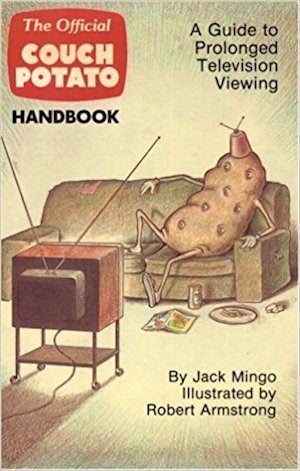
Armstrong, who was a cartoonist, loved the phrase immediately. He sketched a large potato wearing a fez, reclining on a couch with a TV remote, and the image stuck. He went on to trademark the term and use it as the basis for buttons, t-shirts, and a whole Couch Potato merchandising operation.

The Lost in Space Club and the Couch Potatoes

The phone call didn’t come out of nowhere. Iacino and Armstrong were part of a group of friends who gathered on Thursday nights to watch their favorite TV shows together — including Lost in Space, the 1960s sci-fi series. They called themselves the Lost in Space Club.

After Iacino coined the phrase, the group rebranded as the Couch Potatoes. They leaned into the identity: a loose club of people who celebrated television watching as a legitimate leisure activity, at a time when jogging, dieting, and fitness culture were taking over American life. There was something deliberately countercultural about it.

The story gets better. The members’ girlfriends and wives, not wanting to be left out, formed their own splinter group — the Couch Tomatoes — after watching an episode of The Mary Tyler Moore Show together. They called it the beginning of the Equal Rights to the Couch Movement.

In 1982, Jack Mingo formalized the whole mythology in The Official Couch Potato Handbook, co-created with Armstrong. The book detailed the club’s history, philosophy, and even included the Couch Potato Anthem. Armstrong trademarked the terms “Couch Potato” and “Couch Potatoes,” and the phrase began its march into mainstream American vocabulary.

How “Couch Potato” Became Official English

The phrase made its first print appearance in the Los Angeles Times in 1979, describing spectators watching a parade from their couches as they were towed past. By the mid-1980s it was appearing regularly in newspapers and magazines. TV Guide — which was in virtually every American suburban household at the time — helped cement it in the national lexicon.

The phrase was entered into the Oxford English Dictionary in 1993, the gold standard for a word’s official arrival in the language. By that point it had already been in common use for nearly two decades.

Why the Potato Specifically?

The “tuber” wordplay explains the linguistic origin, but “potato” works on another level too — shape. A potato is round, lumpy, and doesn’t do much on its own. The association with someone sitting shapeless on a couch feels almost too apt to be accidental. And then there’s the vegetable connection: “vegging out” has long been used to describe switching off mentally, a reference to being in a vegetative state. A couch potato, then, is someone who has fully committed to vegetating — and the potato is the vegetable that best captures it.

The Official Couch Potato Handbook

In 1982, Jack Mingo wrote The Official Couch Potato Handbook—A Guide to Prolonged Television Viewing, illustrated by Robert Armstrong. According to the book, Mingo trademarked the terms “Couch Potato” and “Couch Potatoes” and copyrighted the Couch Potato Anthem, “Is There Room On the Couch For Me.”

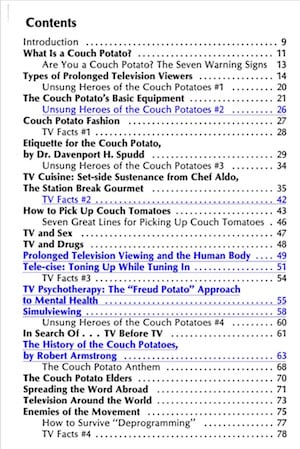
Below, you’ll see the book’s cover, which is still available at Amazon, and a photo of the Table of Contents. Mr. Mingo put some thought into this tantalizing work of nonfiction.

The Couch Potato Handbook   Couch Potato Handbook Contents

In the book, starting on page 63, Jack Mingo writes about the history of the Couch Potatoes. He describes the founding members, including Tom Iacino, and how they would “get together on Thursday nights to follow the adventures of the Space Family Robinson and Dr. Zacary Smith on Lost in Space” (One of my favorite shows at the time)

They called themselves the Lost in Space Club, which eventually turned into the Couch Potatoes after Iacino coined the name. The nine members of this group watched a lot more TV, and soon their lady friends came up with the Couch Tomatoes while watching an episode of the Mary Tyler Moore Show, and “The Equal Rights to the Couch Movement” began.

Check out some more food expressions at Everyday Food Phrases Explained

Leave a Reply

Your email address will not be published. Required fields are marked *

This site uses Akismet to reduce spam. Learn how your comment data is processed.